APC SurgeArrest Personal PER7T (Z98010214399): Difference between revisions
No edit summary |
No edit summary |
||
| (9 intermediate revisions by the same user not shown) | |||
| Line 1: | Line 1: | ||
The '''APC SurgeArrest Personal PER7T''' is a seven-outlet surge protector manufactured by [[APC]] (American Power Conversion) in 1998 as part of the company's SurgeArrest Personal product family. | The '''APC SurgeArrest Personal PER7T''' is a seven-outlet surge protector manufactured by [[APC]] (American Power Conversion) in 1998 as part of the company's consumer-oriented SurgeArrest Personal product family. | ||
Designed to protect personal computers, peripherals, modems, and other household electronics, the PER7T combines AC surge suppression, telephone-line protection, site-wiring diagnostics, and seven grounded outlets within a compact desktop enclosure. | |||
As the first | The documented example is particularly significant because it was manufactured during the production period later affected by the [[APC SurgeArrest Recall (2013)]]. This unit was submitted through APC's recall program in 2021, providing an unusual opportunity to examine a recalled surge protector with documented participation in the replacement process. | ||
As the first SurgeArrest Personal product preserved by the OldSurge Archive, the PER7T expands documentation beyond APC's better-known SurgeArrest Professional family and helps illustrate how APC differentiated consumer and professional surge-protection products during the late 1990s. | |||
<gallery mode="packed" heights="250"> | <gallery mode="packed" heights="250"> | ||
| Line 12: | Line 14: | ||
== Overview == | == Overview == | ||
The APC SurgeArrest Personal PER7T | The APC SurgeArrest Personal PER7T was marketed as a consumer surge protector intended for home and small-office use during the personal-computing era. The design combines seven grounded outlets with integrated telephone-line protection, APC's Protection Working and Site Wiring Fault indicators, and a six-foot power cord for flexible installation. | ||
Although positioned below the company's SurgeArrest Professional product line, teardown examination revealed that the PER7T shares significant design heritage with contemporary Professional-series products. Both families utilize similar enclosure architecture, identical UL listings, comparable protection ratings, and suppression circuitry developed during the same period. | |||
The documented | Internal examination further revealed that APC maintained separate electrical designs for the Personal and Professional product lines despite their outward similarities. The documented PER7T utilizes a dedicated telephone-protection board and a unique surge-suppression board design not presently documented in the archive's Professional-series examples. | ||
The artifact is also significant due to its | The artifact is also historically significant due to its connection with APC's 2013 SurgeArrest recall. The unit remained in service for more than two decades before being submitted through APC's recall program, providing a rare documented example of a recalled surge protector with known recall history. | ||
Together, these characteristics make the PER7T an important reference point for understanding APC's late-1990s consumer surge-protection products and their relationship to the broader SurgeArrest family. | |||
== Historical Context == | == Historical Context == | ||
During the 1990s APC marketed multiple SurgeArrest product families aimed at different segments of the surge-protection market. | During the 1990s APC marketed multiple SurgeArrest product families aimed at different segments of the surge-protection market. The SurgeArrest Professional series targeted business and power users seeking premium protection, while the SurgeArrest Personal series was marketed toward home users and small offices requiring protection for personal computers, peripherals, modems, fax machines, and related electronics. | ||
By the late 1990s personal computers, dial-up Internet access | By the late 1990s personal computers, dial-up Internet access, and networked home offices had become increasingly common. Products such as the PER7T addressed the growing need for affordable protection not only for AC power connections, but also for telephone lines used by modems and communications equipment. | ||
The | The documented example was manufactured in 1998 during the production period later affected by APC's 2013 SurgeArrest recall. As a result, the artifact represents APC's recall-era surge-protection design and provides a useful point of comparison with both earlier and later SurgeArrest products. | ||
Although marketed as part of the Personal family, the PER7T shares substantial design heritage with contemporary APC SurgeArrest Professional products. The documented examples utilize closely related enclosure architecture, identical UL listings, similar diagnostic indicators, and comparable surge-protection ratings. Internal examination, however, revealed that APC maintained separate suppression-board designs for the two product families despite their outward similarities. | |||
The | The PER7T therefore occupies an important position within APC's product history, illustrating how the company adapted a common surge-protection platform to serve different market segments during the personal-computing era. | ||
== Documented Example == | == Documented Example == | ||
| Line 45: | Line 44: | ||
* Serial Number: Z98010214399 | * Serial Number: Z98010214399 | ||
* Manufacturing Date: 1998 | * Manufacturing Date: 1998 | ||
* Recall Status: Included in APC SurgeArrest Recall (2013) | |||
== Specifications == | == Specifications == | ||
The APC SurgeArrest Personal PER7T combines seven grounded outlets, telephone-line protection, diagnostic | The APC SurgeArrest Personal PER7T combines seven grounded outlets, integrated telephone-line protection, diagnostic status indicators, and APC's SurgeArrest surge-suppression technology within a platform closely related to the company's contemporary Professional-series products. Although marketed as part of APC's consumer-oriented Personal family, the PER7T shares a number of specifications and certifications with the archive's documented 1998 PRO7 specimen. | ||
* Manufacturer: APC (American Power Conversion) | * Manufacturer: APC (American Power Conversion) | ||
| Line 85: | Line 84: | ||
* TVSS Ratings: | * TVSS Ratings: | ||
** Line-to-Neutral (L-N): | ** Line-to-Neutral (L-N): 330 V | ||
** Line-to-Ground (L-G): | ** Line-to-Ground (L-G): 330 V | ||
** Neutral-to-Ground (N-G): | ** Neutral-to-Ground (N-G): 330 V | ||
== Notable Characteristics == | == Notable Characteristics == | ||
* First | * First APC SurgeArrest Personal-series product documented by the OldSurge Archive. | ||
* | * Manufactured during the 1993-2002 APC SurgeArrest recall period. | ||
* Integrated | * Integrated single-line telephone protection utilizing dedicated IN and OUT modular jacks. | ||
* | * Protection Working and Site Wiring Fault diagnostic indicators. | ||
* HRSA-manufactured | * HRSA-manufactured SJT 14/3 power cord. | ||
* Documented participation in APC's recall-replacement program. | * Documented participation in APC's recall-replacement program. | ||
* Molded regulatory-information panel rather than | * Molded regulatory-information panel rather than adhesive data labels. | ||
* Seven-screw enclosure construction. | |||
* Two keyhole-style wall-mounting slots. | * Two keyhole-style wall-mounting slots. | ||
* | * Shares UL file number E111219 and 330-volt TVSS ratings with the archive's 1998 APC SurgeArrest Professional PRO7 specimen. | ||
== Weight == | == Weight == | ||
| Line 109: | Line 107: | ||
The weight places the PER7T between the archive's earliest and latest APC SurgeArrest Professional PRO7 examples. The archive's 1998 PRO7 specimen weighs approximately 1 lb 15.9 oz (903 g), while the 2006 and 2017 PRO7 examples each weigh approximately 1 lb 9.6 oz (726 g). | The weight places the PER7T between the archive's earliest and latest APC SurgeArrest Professional PRO7 examples. The archive's 1998 PRO7 specimen weighs approximately 1 lb 15.9 oz (903 g), while the 2006 and 2017 PRO7 examples each weigh approximately 1 lb 9.6 oz (726 g). | ||
Teardown examination revealed that the PER7T utilizes a dedicated AC surge-suppression board, a separate telephone-line protection board, a full-length brass outlet-contact assembly, and integrated diagnostic-indicator circuitry. Despite these features, the unit remains approximately 146 g lighter than the archive's 1998 PRO7 specimen. | |||
The difference appears attributable to APC's use of a smaller suppression-board design within the Personal series. Although the PER7T shares enclosure architecture, certifications, and protection ratings with the contemporary PRO7, internal examination confirmed that the two product families utilize different suppression-board generations and component layouts. | |||
The resulting design occupies a position between APC's higher-end Professional-series products and the simpler consumer surge protectors documented elsewhere in the archive. | |||
File:surge_APC_PER7T_Z98010214399_weight_01.jpg|center|600px|APC SurgeArrest Personal PER7T on a digital scale showing a weight of approximately 1 lb 10.7 oz (757 g). | |||
[[File:surge_APC_PER7T_Z98010214399_weight_01.jpg|center|600px|APC SurgeArrest Personal PER7T on a digital scale showing a weight of approximately 1 lb 10.7 oz (757 g).]] | |||
== Physical Characteristics == | == Physical Characteristics == | ||
The APC SurgeArrest Personal PER7T utilizes a beige molded enclosure measuring approximately 10.25 inches (26.0 cm) long, 4.25 inches (10.8 cm) wide, and 1.75 inches (4.4 cm) tall. | The APC SurgeArrest Personal PER7T utilizes a beige molded-plastic enclosure measuring approximately 10.25 inches (26.0 cm) long, 4.25 inches (10.8 cm) wide, and 1.75 inches (4.4 cm) tall. | ||
The upper surface incorporates seven grounded receptacles arranged in a single row together with APC's | The upper surface incorporates seven grounded receptacles arranged in a single row together with APC's Protection Working and Site Wiring Fault indicators. A black rocker switch is positioned near the cord-entry end of the enclosure, while telephone-line protection is provided through modular IN and OUT connectors located at one end of the housing. | ||
Examination of the telephone-protection connectors and associated circuitry indicates that only the center conductor pair is protected. The design therefore appears intended for a single analog telephone line rather than multi-line service. | |||
The documented | The enclosure architecture closely resembles that of contemporary APC SurgeArrest Professional products documented elsewhere in the archive. Overall dimensions, outlet layout, indicator placement, wall-mounting provisions, and general mechanical construction are substantially similar despite the different product-family branding and internal circuitry. | ||
The | The underside incorporates molded electrical and regulatory information, a serial-number label, two keyhole-style mounting slots, and a holographic UL certification label. Unlike many later APC products documented by the archive, most electrical ratings and certification information are molded directly into the enclosure rather than applied using adhesive labels. | ||
The retained UL hologram identifies the device as a listed UL 1363 Power Tap and UL 1449 TVSS. A molded marking reading "R9802" is also present on the enclosure. The significance of this marking has not been determined and may represent a tooling identifier, mold revision, or manufacturing code. | |||
The documented example utilizes a molded straight-blade NEMA 5-15P attachment plug connected to an approximately six-foot HRSA-manufactured SJT 14/3 power cord. This differs from the archive's contemporary 1998 APC SurgeArrest Professional PRO7 specimen, which utilizes a right-angle attachment plug and a Bon-Eagle-manufactured power cord. | |||
Moderate wear is visible on the grounding pin of the attachment plug, consistent with repeated insertion and removal during service life. Several deep scratches are also present on the underside of the enclosure, particularly near the recessed serial-number area, although the damage appears entirely cosmetic. | |||
Several deep scratches are present on the underside of the enclosure, particularly near the recessed serial-number area | |||
| Line 172: | Line 156: | ||
== Date Codes == | == Date Codes == | ||
The documented specimen is identified by serial number '''Z98010214399'''. According to APC recall documentation, the third and fourth characters of the serial number indicate the year of manufacture, identifying the unit as a 1998 production example. | |||
Disassembly revealed no molded date-code wheels in either enclosure half. This differs from later APC SurgeArrest products documented by the archive, including the 1999 PRO7, which incorporate molded date-code indicators within the enclosure for manufacturing traceability. | |||
The absence of molded date-code features suggests that APC introduced this manufacturing-control practice sometime after production of the documented PER7T specimen. As a result, the serial number provides the primary evidence used to establish the manufacturing date of this artifact. | |||
<gallery mode="packed" heights="250"> | <gallery mode="packed" heights="250"> | ||
File: | File:surge_APC_PER7T_Z98010214399_bottom_SN_01.jpg|Serial-number label identifying the documented specimen as a 1998 production example. | ||
File:surge_APC_PER7T_Z98010214399_teardown_toppanel_left_01.jpg|Interior of the upper housing showing the absence of molded date-code wheels. | |||
File:surge_APC_PER7T_Z98010214399_teardown_toppanel_cordentry_01.jpg|Cord-entry section of the upper housing with no molded date-code indicators present. | |||
</gallery> | </gallery> | ||
== Condition Upon Acquisition == | == Condition Upon Acquisition == | ||
The documented example was acquired in used condition and exhibited cosmetic wear consistent with long-term residential or office | The documented example was acquired in used condition and exhibited cosmetic wear consistent with long-term residential or office service. | ||
The enclosure remained structurally intact and displayed moderate surface wear, minor scuffs, and localized discoloration. Several scratches and abrasion marks were present on both the upper and lower enclosure surfaces, including | The enclosure remained structurally intact and displayed moderate surface wear, minor scuffs, and localized discoloration. Several scratches and abrasion marks were present on both the upper and lower enclosure surfaces, including deep scratches on the underside near the recessed serial-number area. | ||
A transfer mark consistent with contact from an electrical plug or similar object was | A transfer mark consistent with prolonged contact from an electrical plug or similar object was present on the receptacle face near the third outlet from the left. | ||
The attached power cord, plug, rocker switch, indicator lenses, telephone-protection ports, and receptacles appeared complete and undamaged upon initial examination. | The attached power cord, attachment plug, rocker switch, indicator lenses, telephone-protection ports, and receptacles appeared complete and undamaged upon initial examination. | ||
Unlike | Unlike some recalled APC SurgeArrest products documented by the archive, the specimen exhibited no visible evidence of overheating, melted plastic, plug-body separation, heat discoloration, or electrical damage. | ||
The unit was cleaned prior to detailed photography, testing, and internal examination. | The unit was cleaned prior to detailed photography, testing, and internal examination. | ||
<gallery mode="packed" heights="250"> | <gallery mode="packed" heights="250"> | ||
File:surge_APC_PER7T_Z98010214399_beforecleaning_01.jpg| | File:surge_APC_PER7T_Z98010214399_beforecleaning_01.jpg|PER7T as acquired prior to cleaning and detailed documentation. | ||
File:surge_APC_PER7T_Z98010214399_top_switch_01.jpg|Transfer mark visible near the third receptacle from the left. | |||
</gallery> | </gallery> | ||
| Line 201: | Line 191: | ||
The documented example was tested for basic electrical operation, switch functionality, indicator operation, and outlet wiring integrity. | The documented example was tested for basic electrical operation, switch functionality, indicator operation, and outlet wiring integrity. | ||
When connected to utility power and switched ON, the green Protection Working indicator illuminated normally. The red Site Wiring Fault indicator remained unlit | When connected to utility power and switched ON, the green Protection Working indicator illuminated normally. The red Site Wiring Fault indicator remained unlit, indicating that no wiring fault was detected at the test receptacle. | ||
The rocker switch successfully controlled power to all | The rocker switch operated normally and successfully controlled power to all seven outlets throughout testing. | ||
A receptacle tester confirmed correct hot, neutral, and ground connections at the protected outlets. No wiring faults, reversed-polarity conditions, open grounds, or open neutral connections were detected. | |||
The documented | The documented PER7T remained fully operational during testing and exhibited no abnormal behavior, excessive heating, or evidence of electrical malfunction. | ||
<gallery mode="packed" heights="250"> | <gallery mode="packed" heights="250"> | ||
File:surge_APC_PER7T_Z98010214399_testing_pluggedinturnedoff_01.jpg|Connected to utility power with the rocker switch in the OFF position. | File:surge_APC_PER7T_Z98010214399_testing_pluggedinturnedoff_01.jpg|Connected to utility power with the rocker switch in the OFF position and indicators extinguished. | ||
File:surge_APC_PER7T_Z98010214399_testing_pluggedinturnedon_01.jpg|Protection Working indicator illuminated during functional testing. | File:surge_APC_PER7T_Z98010214399_testing_pluggedinturnedon_01.jpg|Protection Working indicator illuminated during functional testing. | ||
File:surge_APC_PER7T_Z98010214399_testing_polaritygrounding_01.jpg|Outlet tester indicating correct wiring and grounding. | File:surge_APC_PER7T_Z98010214399_testing_polaritygrounding_01.jpg|Outlet tester indicating correct wiring and grounding. | ||
| Line 219: | Line 209: | ||
The APC SurgeArrest Personal PER7T enclosure is secured using seven Phillips-head screws and can be opened non-destructively. | The APC SurgeArrest Personal PER7T enclosure is secured using seven Phillips-head screws and can be opened non-destructively. | ||
Removal of the upper housing revealed | Removal of the upper housing revealed a design considerably more sophisticated than many contemporary consumer surge protectors. The PER7T combines a dedicated AC surge-suppression board, an independent telephone-line protection board, a full-length brass outlet-contact assembly, integrated diagnostic indicators, and a resettable circuit-breaker and rocker-switch assembly. | ||
Electrical distribution is accomplished through | Electrical distribution is accomplished through substantial stamped-brass contact assemblies extending the length of the enclosure and serving all seven receptacles. Internal wiring is neatly routed and incorporates dedicated grounding conductors, mechanical strain relief, and molded supports throughout the enclosure. | ||
The upper housing incorporates molded outlet barriers, receptacle-positioning features, structural reinforcement ribs, and mounting provisions for the internal outlet-contact assembly. Overall construction quality is consistent with other APC surge-protection products documented by the archive. | |||
Inspection identified the main surge-suppression circuit board as: | |||
<pre> | |||
AMERICAN POWER CONVERSION | |||
640-0323C | |||
REV 6 | |||
© 1996 | |||
</pre> | |||
Although the board carries the same 1996 copyright year found on the archive's 1998 APC SurgeArrest Professional PRO7 specimen, it represents a different board family. The documented PRO7 utilizes suppression board 640-0321C REV 7, while the PER7T utilizes 640-0323C REV 6. | |||
</ | The suppression circuitry incorporates multiple surge-protection and filtering components, including at least two metal-oxide varistors (MOVs), resistors, capacitors, diagnostic-indicator circuitry, and protective components associated with the Site Wiring Fault and Protection Working indicators. | ||
A primary surge-suppression device is identified as: | |||
<pre> | |||
ZNR | |||
V20201U | |||
</pre> | |||
The suppression board is physically smaller than the assembly documented in the archive's contemporary 1998 PRO7 specimen but remains substantially more sophisticated than the minimalist surge-suppression designs found in some consumer products of the period. | |||
Telephone-line protection is provided by a separate circuit board mounted adjacent to the modular connector assembly. The board carries the marking: | |||
<pre> | |||
014060 | |||
</pre> | |||
The assembly incorporates fuses, diodes, resistors, surge-suppression components, and modular input/output connectors. Examination confirmed that only the center conductor pair is routed through the protection circuitry, indicating protection for a single analog telephone line. The remaining connector positions are not populated. | |||
Disassembly revealed no molded date-code wheels in either enclosure half. This differs from later APC SurgeArrest products documented by the archive, including the archive's 1999 PRO7 specimen, which incorporates molded date-code indicators for manufacturing traceability. The absence of these features suggests that APC introduced this practice sometime after production of the documented 1998 PER7T. | |||
The | The teardown demonstrates that the PER7T was not simply a Professional-series surge protector with telephone protection added. Although the Personal and Professional families share enclosure architecture, certifications, and protection ratings, internal examination revealed distinct suppression-board designs tailored to their respective product families. | ||
<gallery mode="packed" heights="250"> | |||
File:surge_APC_PER7T_Z98010214399_teardown_open_01.jpg|PER7T opened following removal of the seven enclosure screws. | |||
File:surge_APC_PER7T_Z98010214399_teardown_toppanel_left_01.jpg|Upper housing interior showing outlet barriers, receptacle guides, and structural reinforcement features. | |||
File:surge_APC_PER7T_Z98010214399_teardown_bottom_cordentry_01.jpg|Cord-entry section showing the main circuit board, switch assembly, and power-cord termination. | |||
File:surge_APC_PER7T_Z98010214399_teardown_toppanel_cordentry_01.jpg|Cord-entry portion of the upper housing showing internal supports and switch-mounting provisions. | |||
File:surge_APC_PER7T_Z98010214399_teardown_phoneboard_01.jpg|Telephone-line protection circuit board removed for examination. | |||
File:surge_APC_PER7T_Z98010214399_teardown_phoneboard_underneath_01.jpg|Underside of the telephone-protection circuit board showing trace routing and solder connections. | |||
File:surge_APC_PER7T_Z98010214399_teardown_phoneboard_detail_01.jpg|Telephone-line protection circuitry including fuses, diodes, resistors, and surge-suppression components. | |||
File:surge_APC_PER7T_Z98010214399_teardown_mainboard_01.jpg|Main surge-suppression circuit board identified as APC board 640-0323C REV 6. | |||
File:surge_APC_PER7T_Z98010214399_teardown_mainboard_detail_01.jpg|Main-board detail showing MOV surge-suppression components and APC copyright markings. | |||
File:surge_APC_PER7T_Z98010214399_teardown_mainboard_detail_02.jpg|Underside of the suppression board showing trace layout and revision markings. | |||
File:surge_APC_PER7T_Z98010214399_teardown_housingundermainboard_01.jpg|Enclosure area beneath the main suppression board showing mounting supports and internal features. | |||
File:surge_APC_PER7T_Z98010214399_teardown_mainboard_detail_03.jpg|Indicator-circuit detail showing LED connections, resistors, MOVs, and associated components. | |||
</gallery> | |||
== Comparison Notes == | |||
The documented PER7T | The documented APC SurgeArrest Personal PER7T shares substantial design heritage with the archive's 1998 APC SurgeArrest Professional PRO7 specimen. Both products were manufactured during 1998, utilize seven-outlet enclosures of nearly identical dimensions, carry UL file number E111219, employ 330-volt TVSS ratings across all protection modes, and incorporate suppression boards carrying 1996 APC copyright markings. | ||
Despite these similarities, the two products were not electrically identical. Internal examination revealed that the PER7T utilizes suppression board 640-0323C REV 6, while the contemporary PRO7 utilizes board 640-0321C REV 7. The PER7T also incorporates a dedicated telephone-line protection board that is absent from the documented PRO7 example. | |||
Several external differences are also present. The documented PER7T utilizes an HRSA-manufactured six-foot power cord terminated with a straight-blade attachment plug, while the documented PRO7 utilizes a Bon-Eagle-manufactured cord and a right-angle attachment plug. The PER7T additionally provides telephone-line protection through integrated modular connectors and carries SurgeArrest Personal branding rather than SurgeArrest Professional branding. | |||
The | The PER7T weighs approximately 757 g, compared with 903 g for the archive's 1998 PRO7 specimen. Teardown examination suggests that the lower weight is primarily attributable to APC's use of a smaller suppression-board assembly despite retaining similar enclosure architecture and protection ratings. | ||
Together, the two products illustrate APC's practice of adapting a common mechanical platform to serve different segments of the surge-protection market. While the Personal and Professional families shared substantial mechanical and regulatory commonality, APC maintained distinct electrical designs and feature sets for each product line. | |||
== Recall Information == | == Recall Information == | ||
| Line 271: | Line 293: | ||
== Historical References == | == Historical References == | ||
The APC SurgeArrest Personal series formed part of APC's broader SurgeArrest product lineup during the late 1990s. Contemporary APC marketing materials positioned Personal-series products as surge-protection solutions for home computers, peripherals, modems, fax machines, and other consumer electronics. | |||
Archived APC product literature from November 1999 documents the coexistence of multiple SurgeArrest families, including Professional, Personal, Notebook, Residential, and related protection products. The documented PER7T illustrates APC's consumer-oriented approach to surge protection during this period while retaining many characteristics shared with the company's Professional-series designs. | |||
[[File:19991117_apcc.com_archive.org_surgeproducts.png|center|700px|Archived APC surge-protection product lineup captured in November 1999.]] | |||
* [[APC]] | |||
* [[APC SurgeArrest Personal]] | |||
* [[APC SurgeArrest Recall (2013)]] | |||
* [[PC Magazine References]] | |||
== Notes == | == Notes == | ||
* | * First documented APC SurgeArrest Personal-series artifact preserved by the OldSurge Archive. | ||
* | * Accompanied by documentation indicating participation in APC's recall-replacement program during 2021. | ||
* | * Utilizes suppression board 640-0323C REV 6, distinct from the 640-0321-series boards documented in contemporary APC SurgeArrest Professional products. | ||
* Telephone-line protection is implemented using a dedicated protection board rather than integration into the primary surge-suppression assembly. | |||
* No molded date-code wheels were observed within the enclosure. | |||
* Documents APC's use of an HRSA-manufactured power cord during the late 1990s. | |||
== Related Articles == | == Related Articles == | ||
* [[ | * [[APC]] | ||
* [[ | * [[APC SurgeArrest Personal]] | ||
* [[APC SurgeArrest Professional]] | |||
* [[APC SurgeArrest Professional PRO7 (Z98010201706)]] | |||
* [[APC SurgeArrest Recall (2013)]] | |||
* [[Power Cord Comparison]] | |||
* [[Surge Protectors]] | * [[Surge Protectors]] | ||
* [[Collection Index]] | * [[Collection Index]] | ||
* [[OldSurge Accession Register]] | |||
[[Category:Surge Protectors]] | [[Category:Surge Protectors]] | ||
Latest revision as of 23:34, 26 October 2026
The APC SurgeArrest Personal PER7T is a seven-outlet surge protector manufactured by APC (American Power Conversion) in 1998 as part of the company's consumer-oriented SurgeArrest Personal product family.
Designed to protect personal computers, peripherals, modems, and other household electronics, the PER7T combines AC surge suppression, telephone-line protection, site-wiring diagnostics, and seven grounded outlets within a compact desktop enclosure.
The documented example is particularly significant because it was manufactured during the production period later affected by the APC SurgeArrest Recall (2013). This unit was submitted through APC's recall program in 2021, providing an unusual opportunity to examine a recalled surge protector with documented participation in the replacement process.
As the first SurgeArrest Personal product preserved by the OldSurge Archive, the PER7T expands documentation beyond APC's better-known SurgeArrest Professional family and helps illustrate how APC differentiated consumer and professional surge-protection products during the late 1990s.
-
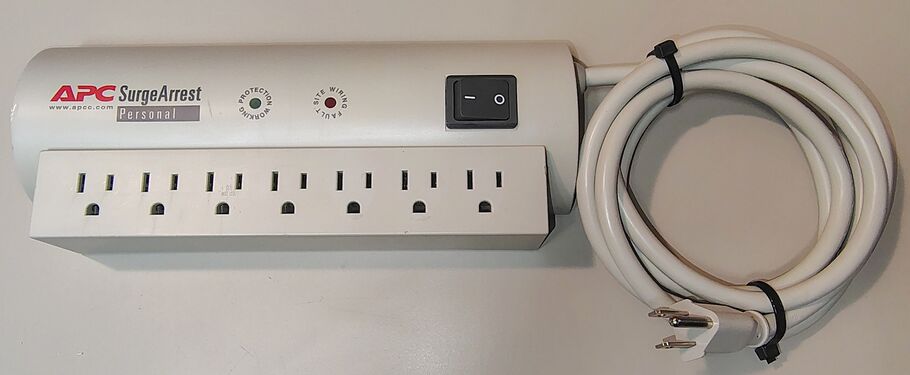 Overall view of the documented APC SurgeArrest Personal PER7T specimen.

Overview
The APC SurgeArrest Personal PER7T was marketed as a consumer surge protector intended for home and small-office use during the personal-computing era. The design combines seven grounded outlets with integrated telephone-line protection, APC's Protection Working and Site Wiring Fault indicators, and a six-foot power cord for flexible installation.
Although positioned below the company's SurgeArrest Professional product line, teardown examination revealed that the PER7T shares significant design heritage with contemporary Professional-series products. Both families utilize similar enclosure architecture, identical UL listings, comparable protection ratings, and suppression circuitry developed during the same period.
Internal examination further revealed that APC maintained separate electrical designs for the Personal and Professional product lines despite their outward similarities. The documented PER7T utilizes a dedicated telephone-protection board and a unique surge-suppression board design not presently documented in the archive's Professional-series examples.
The artifact is also historically significant due to its connection with APC's 2013 SurgeArrest recall. The unit remained in service for more than two decades before being submitted through APC's recall program, providing a rare documented example of a recalled surge protector with known recall history.
Together, these characteristics make the PER7T an important reference point for understanding APC's late-1990s consumer surge-protection products and their relationship to the broader SurgeArrest family.
Historical Context
During the 1990s APC marketed multiple SurgeArrest product families aimed at different segments of the surge-protection market. The SurgeArrest Professional series targeted business and power users seeking premium protection, while the SurgeArrest Personal series was marketed toward home users and small offices requiring protection for personal computers, peripherals, modems, fax machines, and related electronics.
By the late 1990s personal computers, dial-up Internet access, and networked home offices had become increasingly common. Products such as the PER7T addressed the growing need for affordable protection not only for AC power connections, but also for telephone lines used by modems and communications equipment.
The documented example was manufactured in 1998 during the production period later affected by APC's 2013 SurgeArrest recall. As a result, the artifact represents APC's recall-era surge-protection design and provides a useful point of comparison with both earlier and later SurgeArrest products.
Although marketed as part of the Personal family, the PER7T shares substantial design heritage with contemporary APC SurgeArrest Professional products. The documented examples utilize closely related enclosure architecture, identical UL listings, similar diagnostic indicators, and comparable surge-protection ratings. Internal examination, however, revealed that APC maintained separate suppression-board designs for the two product families despite their outward similarities.
The PER7T therefore occupies an important position within APC's product history, illustrating how the company adapted a common surge-protection platform to serve different market segments during the personal-computing era.
Documented Example
- OldSurge ID: OS-0029
- Manufacturer: APC (American Power Conversion)
- Product Family: SurgeArrest Personal
- Model: PER7T
- Serial Number: Z98010214399
- Manufacturing Date: 1998
- Recall Status: Included in APC SurgeArrest Recall (2013)
Specifications
The APC SurgeArrest Personal PER7T combines seven grounded outlets, integrated telephone-line protection, diagnostic status indicators, and APC's SurgeArrest surge-suppression technology within a platform closely related to the company's contemporary Professional-series products. Although marketed as part of APC's consumer-oriented Personal family, the PER7T shares a number of specifications and certifications with the archive's documented 1998 PRO7 specimen.
- Manufacturer: APC (American Power Conversion)
- Product Family: APC SurgeArrest Personal
- Model: PER7T
- Device Type: Surge Protector
- Country of Origin: China
- Outlets: 7 grounded outlets
- Protection: AC power-line surge suppression, telephone-line protection
- Length: Approximately 10.25 in (26.0 cm)
- Width: Approximately 4.25 in (10.8 cm)
- Height: Approximately 1.75 in (4.4 cm)
- Weight: 1 lb 10.7 oz (757 g)
- Plug Type: NEMA 5-15P
- Plug Style: Straight-Blade
- Power Cord:
- Length: Approximately 6 ft (1.83 m)
- Type: SJT
- Conductors: 3
- Wire Size: 14 AWG
- Flame Rating: FT2
- Temperature Rating: 75°C (UL), 60°C (CSA)
- Manufacturer: HRSA
- UL File Number: E69167
- CSA File Number: LL52902
- Surge Protector UL File Number: E111219
- UL 1363 Power Tap
- UL 1449 TVSS
- TVSS Ratings:
- Line-to-Neutral (L-N): 330 V
- Line-to-Ground (L-G): 330 V
- Neutral-to-Ground (N-G): 330 V
Notable Characteristics
- First APC SurgeArrest Personal-series product documented by the OldSurge Archive.
- Manufactured during the 1993-2002 APC SurgeArrest recall period.
- Integrated single-line telephone protection utilizing dedicated IN and OUT modular jacks.
- Protection Working and Site Wiring Fault diagnostic indicators.
- HRSA-manufactured SJT 14/3 power cord.
- Documented participation in APC's recall-replacement program.
- Molded regulatory-information panel rather than adhesive data labels.
- Seven-screw enclosure construction.
- Two keyhole-style wall-mounting slots.
- Shares UL file number E111219 and 330-volt TVSS ratings with the archive's 1998 APC SurgeArrest Professional PRO7 specimen.
Weight
The documented APC SurgeArrest Personal PER7T weighs approximately 1 lb 10.7 oz (757 g).
The weight places the PER7T between the archive's earliest and latest APC SurgeArrest Professional PRO7 examples. The archive's 1998 PRO7 specimen weighs approximately 1 lb 15.9 oz (903 g), while the 2006 and 2017 PRO7 examples each weigh approximately 1 lb 9.6 oz (726 g).
Teardown examination revealed that the PER7T utilizes a dedicated AC surge-suppression board, a separate telephone-line protection board, a full-length brass outlet-contact assembly, and integrated diagnostic-indicator circuitry. Despite these features, the unit remains approximately 146 g lighter than the archive's 1998 PRO7 specimen.
The difference appears attributable to APC's use of a smaller suppression-board design within the Personal series. Although the PER7T shares enclosure architecture, certifications, and protection ratings with the contemporary PRO7, internal examination confirmed that the two product families utilize different suppression-board generations and component layouts.
The resulting design occupies a position between APC's higher-end Professional-series products and the simpler consumer surge protectors documented elsewhere in the archive.

Physical Characteristics
The APC SurgeArrest Personal PER7T utilizes a beige molded-plastic enclosure measuring approximately 10.25 inches (26.0 cm) long, 4.25 inches (10.8 cm) wide, and 1.75 inches (4.4 cm) tall.
The upper surface incorporates seven grounded receptacles arranged in a single row together with APC's Protection Working and Site Wiring Fault indicators. A black rocker switch is positioned near the cord-entry end of the enclosure, while telephone-line protection is provided through modular IN and OUT connectors located at one end of the housing.
Examination of the telephone-protection connectors and associated circuitry indicates that only the center conductor pair is protected. The design therefore appears intended for a single analog telephone line rather than multi-line service.
The enclosure architecture closely resembles that of contemporary APC SurgeArrest Professional products documented elsewhere in the archive. Overall dimensions, outlet layout, indicator placement, wall-mounting provisions, and general mechanical construction are substantially similar despite the different product-family branding and internal circuitry.
The underside incorporates molded electrical and regulatory information, a serial-number label, two keyhole-style mounting slots, and a holographic UL certification label. Unlike many later APC products documented by the archive, most electrical ratings and certification information are molded directly into the enclosure rather than applied using adhesive labels.
The retained UL hologram identifies the device as a listed UL 1363 Power Tap and UL 1449 TVSS. A molded marking reading "R9802" is also present on the enclosure. The significance of this marking has not been determined and may represent a tooling identifier, mold revision, or manufacturing code.
The documented example utilizes a molded straight-blade NEMA 5-15P attachment plug connected to an approximately six-foot HRSA-manufactured SJT 14/3 power cord. This differs from the archive's contemporary 1998 APC SurgeArrest Professional PRO7 specimen, which utilizes a right-angle attachment plug and a Bon-Eagle-manufactured power cord.
Moderate wear is visible on the grounding pin of the attachment plug, consistent with repeated insertion and removal during service life. Several deep scratches are also present on the underside of the enclosure, particularly near the recessed serial-number area, although the damage appears entirely cosmetic.
Photographs
-
Overall view of the documented APC SurgeArrest Personal PER7T specimen.
-
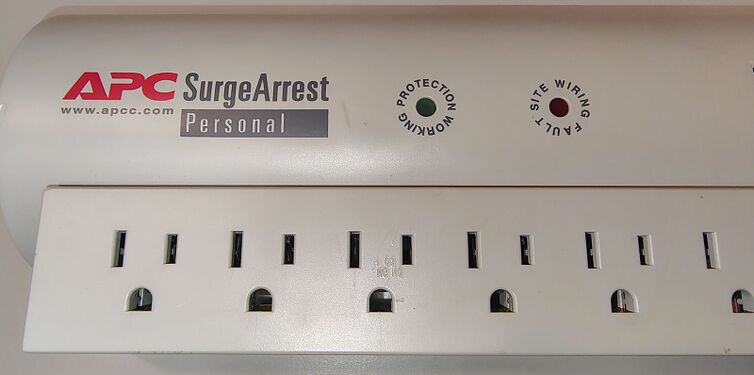 SurgeArrest Personal branding with Protection Working and Site Wiring Fault indicators.
-
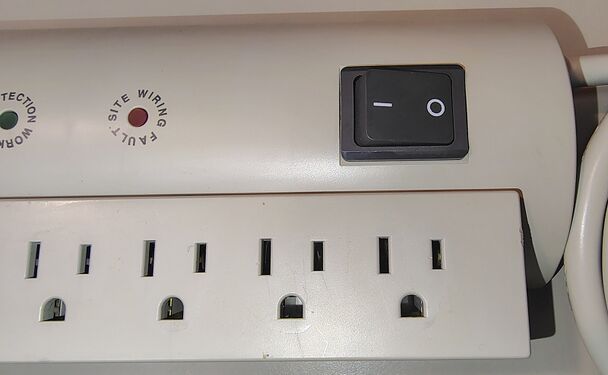 Power-switch area showing indicator layout and receptacle detail.
-
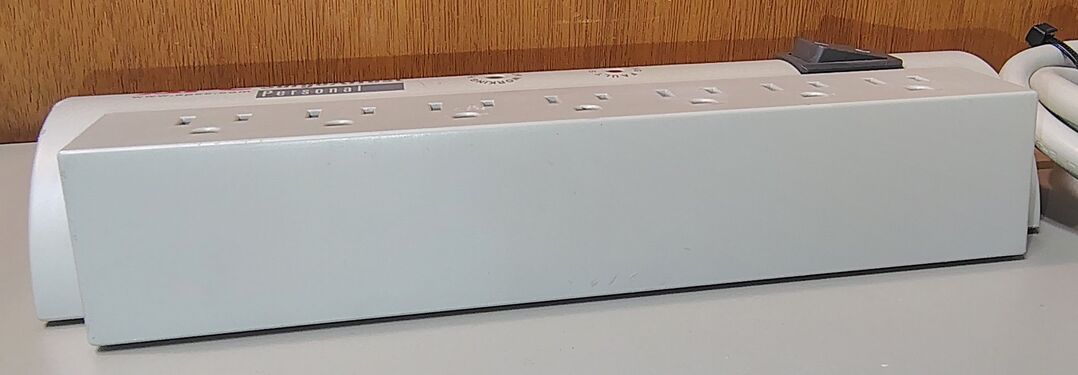 Side profile showing the rectangular receptacle section and curved upper housing.
-
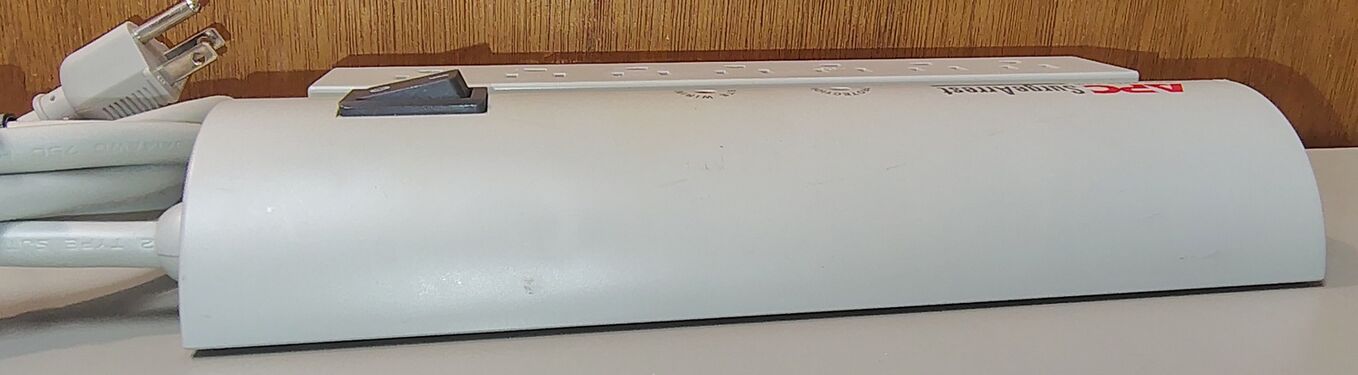 Opposite side profile showing the smooth enclosure design and switch housing.
-
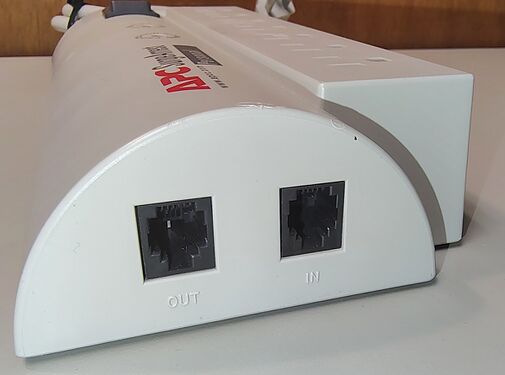 Telephone-line protection ports with input and output connections.
-
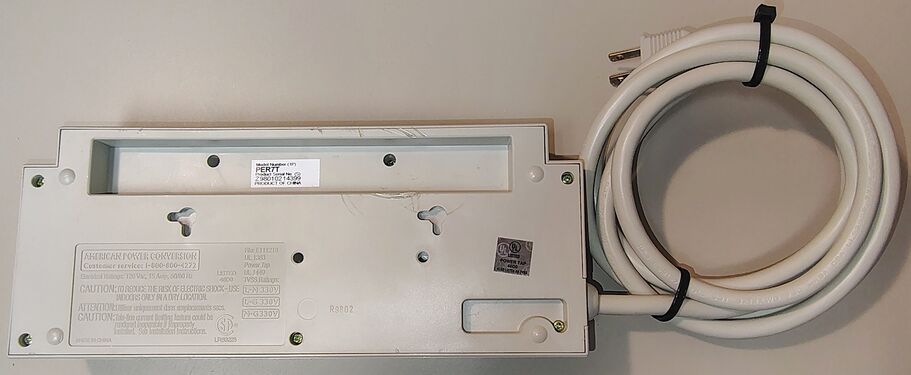 Underside overview showing molded regulatory information, mounting provisions, serial-number label, and attached power cord.
-
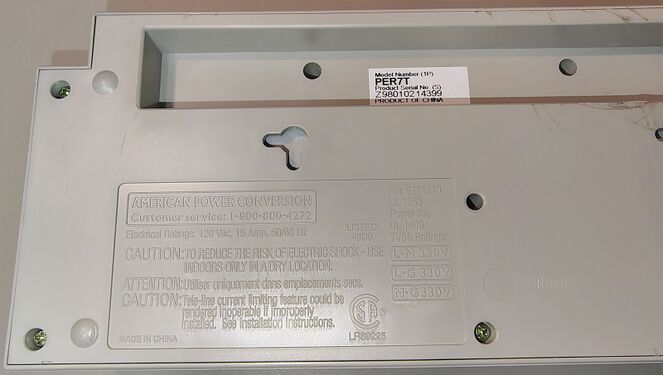 Molded regulatory-information panel showing electrical ratings, UL listings, and TVSS voltage ratings.
-
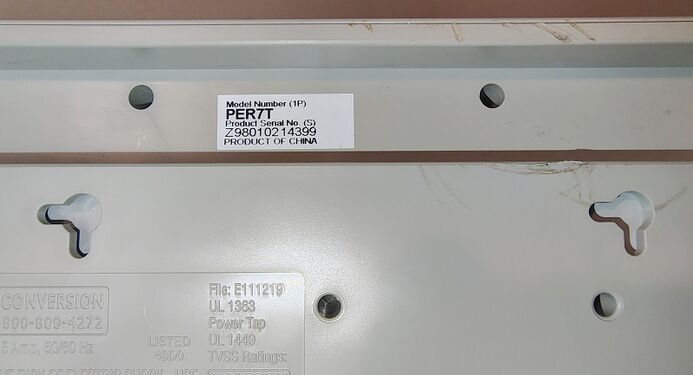 Model and serial-number label identifying the documented PER7T specimen.
-
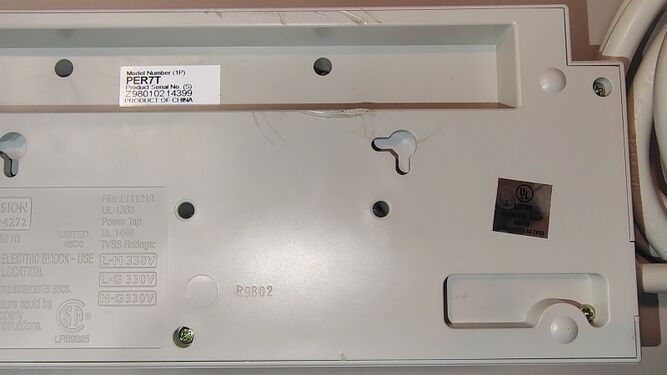 Cord-entry underside detail showing the serial-number label, mounting provisions, and UL hologram label.
-
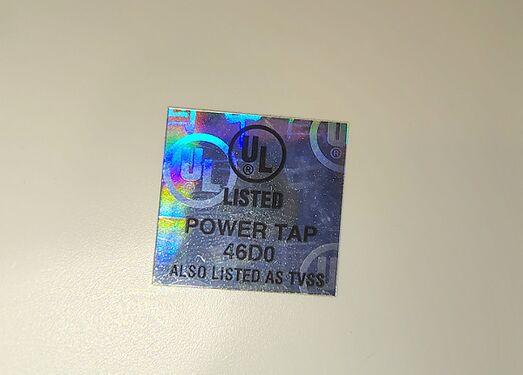 UL hologram label identifying the device as a listed Power Tap and TVSS.
-
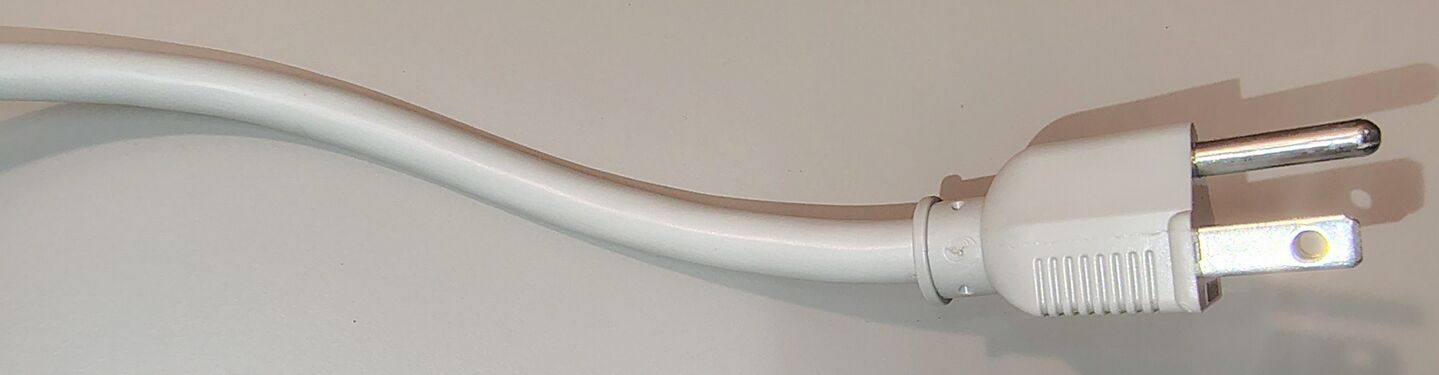 Attached six-foot power cord and molded straight-blade attachment plug.
-
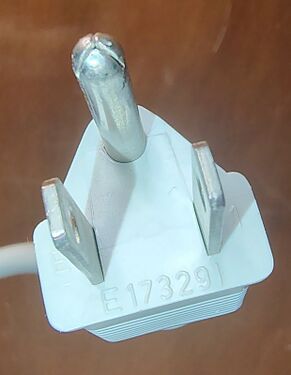 Close-up of the attachment plug showing molded identification markings and grounding-pin wear.
-
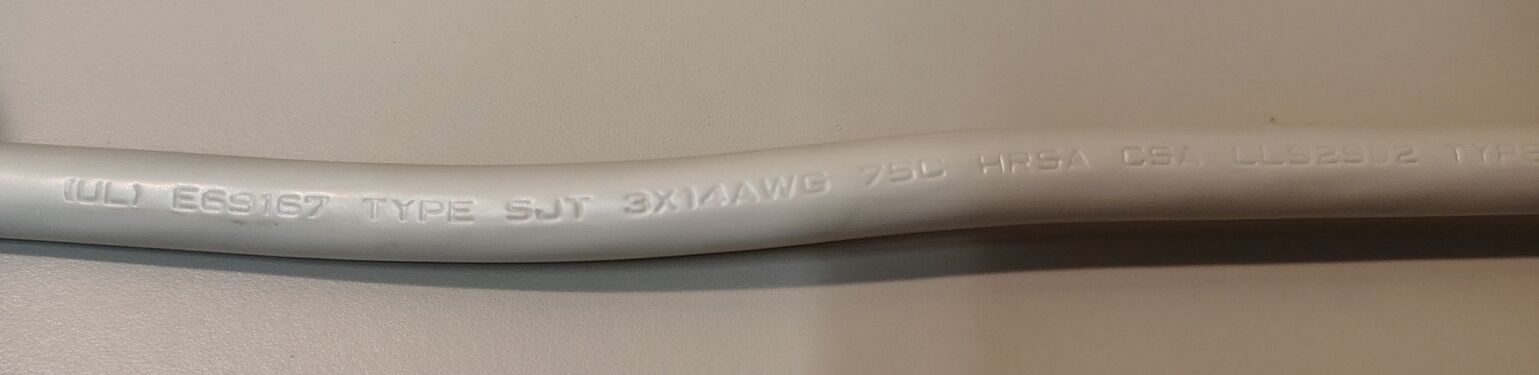 Power-cord markings showing HRSA manufacturer identification, UL file number E69167, and SJT 14 AWG construction.
-
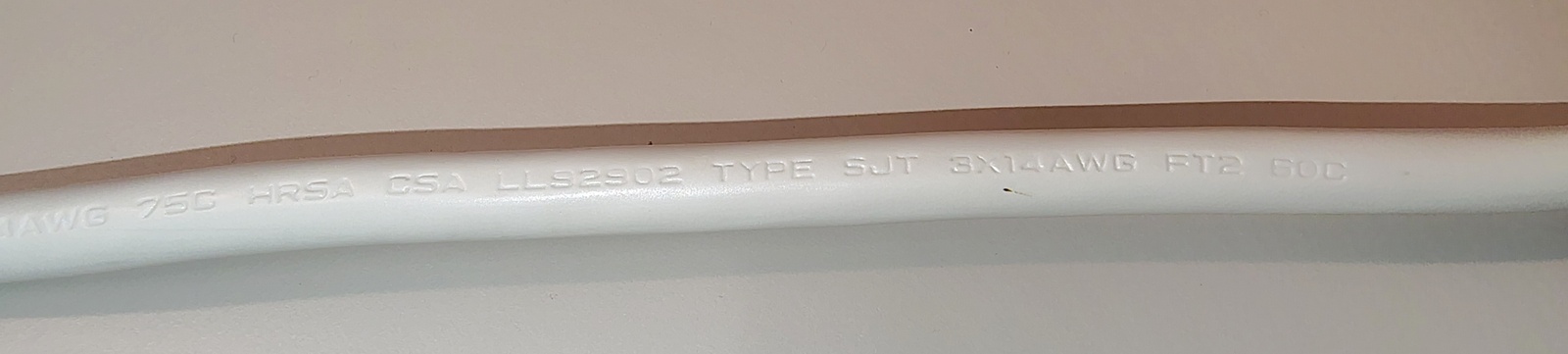 Additional power-cord markings showing CSA file number LL52902, FT2 flame rating, and conductor specifications.


Date Codes
The documented specimen is identified by serial number Z98010214399. According to APC recall documentation, the third and fourth characters of the serial number indicate the year of manufacture, identifying the unit as a 1998 production example.
Disassembly revealed no molded date-code wheels in either enclosure half. This differs from later APC SurgeArrest products documented by the archive, including the 1999 PRO7, which incorporate molded date-code indicators within the enclosure for manufacturing traceability.
The absence of molded date-code features suggests that APC introduced this manufacturing-control practice sometime after production of the documented PER7T specimen. As a result, the serial number provides the primary evidence used to establish the manufacturing date of this artifact.
-
Serial-number label identifying the documented specimen as a 1998 production example.
-
 Interior of the upper housing showing the absence of molded date-code wheels.
-
 Cord-entry section of the upper housing with no molded date-code indicators present.


Condition Upon Acquisition
The documented example was acquired in used condition and exhibited cosmetic wear consistent with long-term residential or office service.
The enclosure remained structurally intact and displayed moderate surface wear, minor scuffs, and localized discoloration. Several scratches and abrasion marks were present on both the upper and lower enclosure surfaces, including deep scratches on the underside near the recessed serial-number area.
A transfer mark consistent with prolonged contact from an electrical plug or similar object was present on the receptacle face near the third outlet from the left.
The attached power cord, attachment plug, rocker switch, indicator lenses, telephone-protection ports, and receptacles appeared complete and undamaged upon initial examination.
Unlike some recalled APC SurgeArrest products documented by the archive, the specimen exhibited no visible evidence of overheating, melted plastic, plug-body separation, heat discoloration, or electrical damage.
The unit was cleaned prior to detailed photography, testing, and internal examination.
-
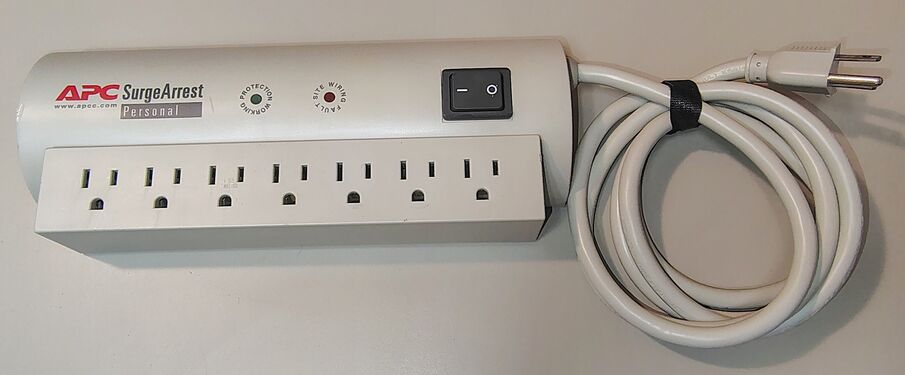 PER7T as acquired prior to cleaning and detailed documentation.
-
Transfer mark visible near the third receptacle from the left.

Functional Testing
The documented example was tested for basic electrical operation, switch functionality, indicator operation, and outlet wiring integrity.
When connected to utility power and switched ON, the green Protection Working indicator illuminated normally. The red Site Wiring Fault indicator remained unlit, indicating that no wiring fault was detected at the test receptacle.
The rocker switch operated normally and successfully controlled power to all seven outlets throughout testing.
A receptacle tester confirmed correct hot, neutral, and ground connections at the protected outlets. No wiring faults, reversed-polarity conditions, open grounds, or open neutral connections were detected.
The documented PER7T remained fully operational during testing and exhibited no abnormal behavior, excessive heating, or evidence of electrical malfunction.
-
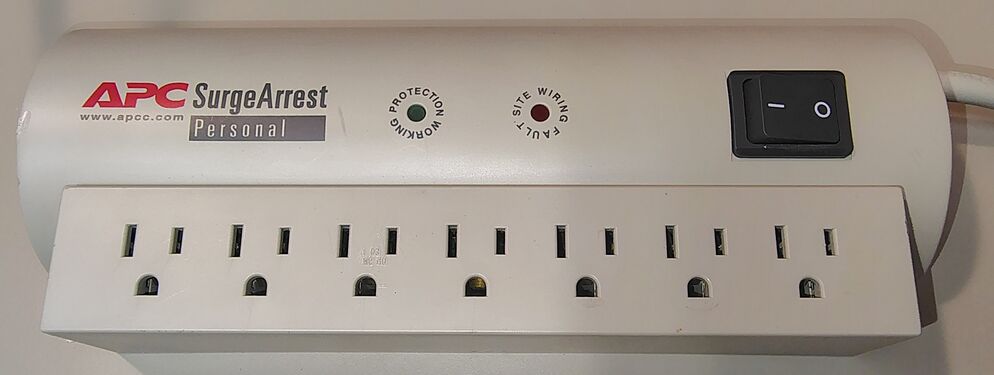 Connected to utility power with the rocker switch in the OFF position and indicators extinguished.
-
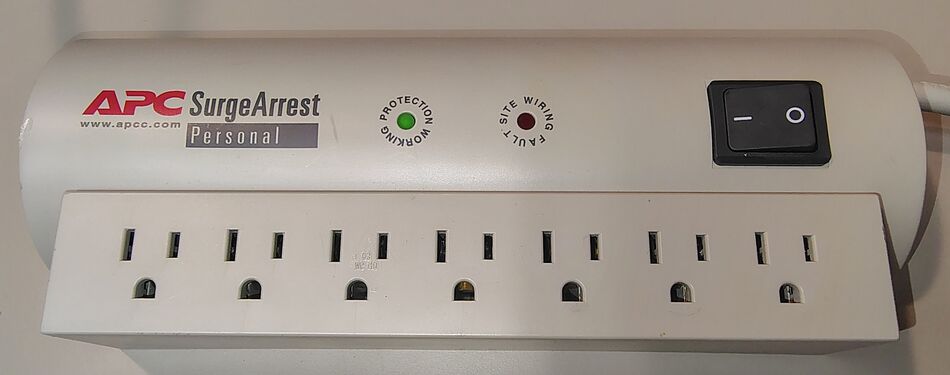 Protection Working indicator illuminated during functional testing.
-
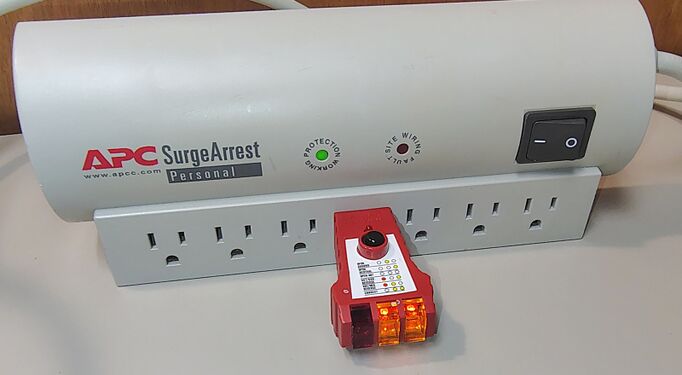 Outlet tester indicating correct wiring and grounding.


Teardown
The APC SurgeArrest Personal PER7T enclosure is secured using seven Phillips-head screws and can be opened non-destructively.
Removal of the upper housing revealed a design considerably more sophisticated than many contemporary consumer surge protectors. The PER7T combines a dedicated AC surge-suppression board, an independent telephone-line protection board, a full-length brass outlet-contact assembly, integrated diagnostic indicators, and a resettable circuit-breaker and rocker-switch assembly.
Electrical distribution is accomplished through substantial stamped-brass contact assemblies extending the length of the enclosure and serving all seven receptacles. Internal wiring is neatly routed and incorporates dedicated grounding conductors, mechanical strain relief, and molded supports throughout the enclosure.
The upper housing incorporates molded outlet barriers, receptacle-positioning features, structural reinforcement ribs, and mounting provisions for the internal outlet-contact assembly. Overall construction quality is consistent with other APC surge-protection products documented by the archive.
Inspection identified the main surge-suppression circuit board as:
AMERICAN POWER CONVERSION
640-0323C
REV 6
© 1996
Although the board carries the same 1996 copyright year found on the archive's 1998 APC SurgeArrest Professional PRO7 specimen, it represents a different board family. The documented PRO7 utilizes suppression board 640-0321C REV 7, while the PER7T utilizes 640-0323C REV 6.
The suppression circuitry incorporates multiple surge-protection and filtering components, including at least two metal-oxide varistors (MOVs), resistors, capacitors, diagnostic-indicator circuitry, and protective components associated with the Site Wiring Fault and Protection Working indicators.
A primary surge-suppression device is identified as:
ZNR
V20201U
The suppression board is physically smaller than the assembly documented in the archive's contemporary 1998 PRO7 specimen but remains substantially more sophisticated than the minimalist surge-suppression designs found in some consumer products of the period.
Telephone-line protection is provided by a separate circuit board mounted adjacent to the modular connector assembly. The board carries the marking:
014060
The assembly incorporates fuses, diodes, resistors, surge-suppression components, and modular input/output connectors. Examination confirmed that only the center conductor pair is routed through the protection circuitry, indicating protection for a single analog telephone line. The remaining connector positions are not populated.
Disassembly revealed no molded date-code wheels in either enclosure half. This differs from later APC SurgeArrest products documented by the archive, including the archive's 1999 PRO7 specimen, which incorporates molded date-code indicators for manufacturing traceability. The absence of these features suggests that APC introduced this practice sometime after production of the documented 1998 PER7T.
The teardown demonstrates that the PER7T was not simply a Professional-series surge protector with telephone protection added. Although the Personal and Professional families share enclosure architecture, certifications, and protection ratings, internal examination revealed distinct suppression-board designs tailored to their respective product families.
-
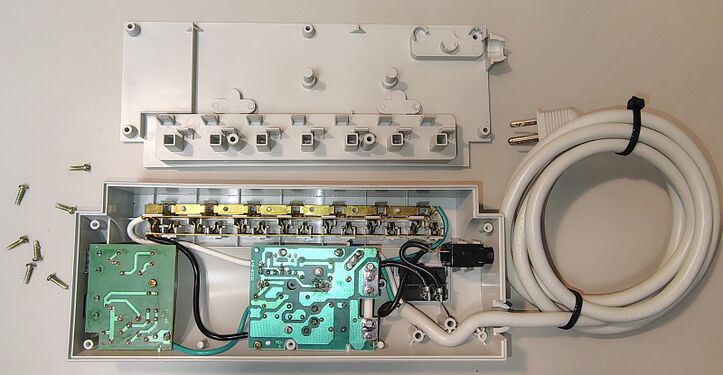 PER7T opened following removal of the seven enclosure screws.
-
Upper housing interior showing outlet barriers, receptacle guides, and structural reinforcement features.
-
 Cord-entry section showing the main circuit board, switch assembly, and power-cord termination.
-
Cord-entry portion of the upper housing showing internal supports and switch-mounting provisions.
-
 Telephone-line protection circuit board removed for examination.
-
 Underside of the telephone-protection circuit board showing trace routing and solder connections.
-
 Telephone-line protection circuitry including fuses, diodes, resistors, and surge-suppression components.
-
 Main surge-suppression circuit board identified as APC board 640-0323C REV 6.
-
 Main-board detail showing MOV surge-suppression components and APC copyright markings.
-
 Underside of the suppression board showing trace layout and revision markings.
-
 Enclosure area beneath the main suppression board showing mounting supports and internal features.
-
 Indicator-circuit detail showing LED connections, resistors, MOVs, and associated components.


Comparison Notes
The documented APC SurgeArrest Personal PER7T shares substantial design heritage with the archive's 1998 APC SurgeArrest Professional PRO7 specimen. Both products were manufactured during 1998, utilize seven-outlet enclosures of nearly identical dimensions, carry UL file number E111219, employ 330-volt TVSS ratings across all protection modes, and incorporate suppression boards carrying 1996 APC copyright markings.
Despite these similarities, the two products were not electrically identical. Internal examination revealed that the PER7T utilizes suppression board 640-0323C REV 6, while the contemporary PRO7 utilizes board 640-0321C REV 7. The PER7T also incorporates a dedicated telephone-line protection board that is absent from the documented PRO7 example.
Several external differences are also present. The documented PER7T utilizes an HRSA-manufactured six-foot power cord terminated with a straight-blade attachment plug, while the documented PRO7 utilizes a Bon-Eagle-manufactured cord and a right-angle attachment plug. The PER7T additionally provides telephone-line protection through integrated modular connectors and carries SurgeArrest Personal branding rather than SurgeArrest Professional branding.
The PER7T weighs approximately 757 g, compared with 903 g for the archive's 1998 PRO7 specimen. Teardown examination suggests that the lower weight is primarily attributable to APC's use of a smaller suppression-board assembly despite retaining similar enclosure architecture and protection ratings.
Together, the two products illustrate APC's practice of adapting a common mechanical platform to serve different segments of the surge-protection market. While the Personal and Professional families shared substantial mechanical and regulatory commonality, APC maintained distinct electrical designs and feature sets for each product line.
Recall Information
The APC SurgeArrest Personal PER7T was included in APC's 2013 SurgeArrest recall affecting approximately 15 million APC 7-Series and 8-Series surge protectors manufactured between 1993 and 2002.
According to APC and the U.S. Consumer Product Safety Commission (CPSC), affected units could overheat, smoke, melt, and pose a fire hazard. The recall included multiple SurgeArrest product families, including the Personal, Professional, Performance, and Network series.
The documented example carries serial number Z98010214399 and was manufactured in 1998, placing it within the affected recall period.
Documentation accompanying the artifact indicates that the unit was submitted to APC's recall program in June 2021. A replacement APC SurgeArrest surge protector manufactured in 2021 was reportedly received through the recall process and remains preserved alongside the recalled specimen.
As a result, this artifact represents a rare documented example of a recalled APC SurgeArrest product with a known recall-participation history.
Historical References
The APC SurgeArrest Personal series formed part of APC's broader SurgeArrest product lineup during the late 1990s. Contemporary APC marketing materials positioned Personal-series products as surge-protection solutions for home computers, peripherals, modems, fax machines, and other consumer electronics.
Archived APC product literature from November 1999 documents the coexistence of multiple SurgeArrest families, including Professional, Personal, Notebook, Residential, and related protection products. The documented PER7T illustrates APC's consumer-oriented approach to surge protection during this period while retaining many characteristics shared with the company's Professional-series designs.

Notes
- First documented APC SurgeArrest Personal-series artifact preserved by the OldSurge Archive.
- Accompanied by documentation indicating participation in APC's recall-replacement program during 2021.
- Utilizes suppression board 640-0323C REV 6, distinct from the 640-0321-series boards documented in contemporary APC SurgeArrest Professional products.
- Telephone-line protection is implemented using a dedicated protection board rather than integration into the primary surge-suppression assembly.
- No molded date-code wheels were observed within the enclosure.
- Documents APC's use of an HRSA-manufactured power cord during the late 1990s.