PowerSentry 626
The PowerSentry Model 626 is a seven-outlet surge protector manufactured by PowerSentry, a division of Fiskars Consumer Products, Inc.
The documented example was manufactured on 20 October 2002 and incorporates several design features not previously documented by the OldSurge Archive, including a push-button latching power switch, integrated cord-storage guides, and a plug-mounted cord-retention clip.
Despite extensive review of surviving 2003 and 2004 PowerSentry product catalogs preserved by Archive.org, the Model 626 has not yet been identified within available product literature, making its exact position within the PowerSentry product lineup uncertain.

Overview
General description of the product, manufacturer, purpose, historical significance, and why this example is noteworthy.
Historical Context
Describe where the product fits within its manufacturer lineup, market segment, technological era, or product family.
Examples:
- Consumer vs commercial product
- OEM vs retail product
- Relationship to recalls
- Introduction of new features
- Differences from previous generations
Documented Example
- OldSurge ID: OS-XXXX
- Manufacturer:
- Model:
- Part Number:
- Serial Number:
- Manufacturing Date:
Specifications
Short introductory paragraph explaining what makes the specifications noteworthy.
- Manufacturer:
- Product Family:
- Model:
- Device Type:
- Country of Origin:
- Outlets:
- Protection:
- Length:
- Width:
- Height:
- Weight:
- Power Cord Length:
- Plug Type:
- Plug Style:
- Cord Type:
- Conductors:
- UL File Number:
- CSA File Number:
Notable Characteristics
- Manufactured 20 October 2002 (date wheels).
- Earliest documented PowerSentry surge protector preserved by the OldSurge Archive.
- First documented push-button latching power switch.
- First documented surge protector incorporating a plug-mounted cord-retention clip.
- First documented surge protector incorporating integrated cord-storage guides on both ends of the enclosure.
- Seven grounded NEMA 5-15R receptacles.
- Ground and Surge status indicators.
- Manufactured during the period represented by surviving 2003-2004 PowerSentry product literature.
Weight
Weight discussion and comparison with related products.
Physical Characteristics
The PowerSentry 626 utilizes an elongated tapered enclosure measuring approximately 14.88 inches long, 2.50 inches wide at the center, 1.88 inches wide at the ends, and approximately 1.50 inches tall.
Seven grounded receptacles are arranged in a single row along the front surface of the enclosure.
The control section incorporates a push-button latching power switch together with Ground and Surge status indicators. Unlike rocker switches documented on many other surge protectors in the archive, the switch remains mechanically latched in either the ON or OFF position.
Integrated cord-management features are present at both ends of the enclosure and permit the attached power cord to be wrapped around the body of the surge protector for storage.
The attachment plug incorporates an integrated cord-retention clip similar to those commonly found on vacuum-cleaner power cords.
Photographs
-
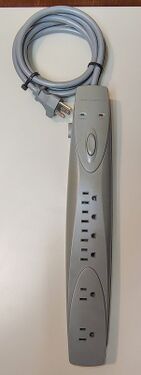 Overall view of the documented PowerSentry Model 626 showing the elongated enclosure, seven grounded outlets, and integrated cord-management features.
 -
 Outlet detail showing the seven grounded receptacles and tapered enclosure profile.
 -
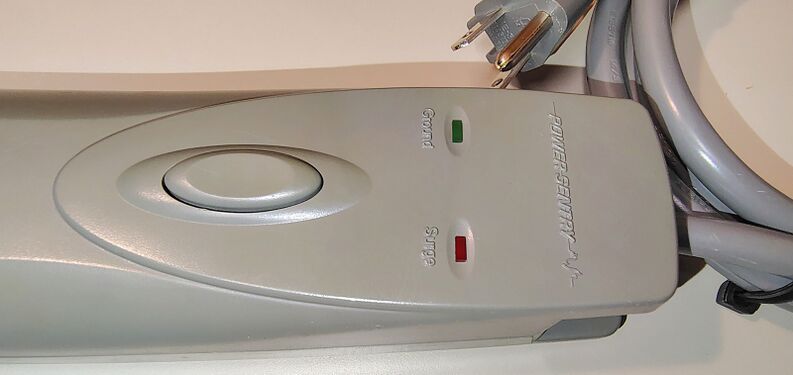 Control section showing the push-button power switch, Ground indicator, and Surge indicator.


Date Codes
Discussion of serial numbers, molded date wheels, labels, component date codes, manufacturing evidence, and production chronology.
-
Date-code detail.

Condition Upon Acquisition
Description of condition as acquired.

Functional Testing
Description of operational testing, polarity testing, indicator operation, and test results.
-
Testing photograph.

Teardown
Description of disassembly, construction details, PCB markings, suppression components, wiring, safety features, and observations.
Include analysis whenever possible:
- How does construction compare to earlier models?
- Is the design unusually robust or simplified?
- What does it suggest about the target market?
-
Internal construction.

Comparison Notes
Compare against similar examples already documented by the archive.
Examples:
- Earlier and later revisions
- Different PCB generations
- Different levels of enclosure aging
- Weight differences
- Changes in manufacturing location
Recall Information
If applicable.
Historical References
Historical advertisements, archived manufacturer literature, patents, magazine references, archived web captures, and period specifications.

Notes
- Additional observations.
- Manufacturing details.
- Interesting findings.