PC Magazine References: Difference between revisions
| Line 124: | Line 124: | ||
File:PCMagazine_July1995_fileserverl_01.jpg|PC Magazine's July 1995 "Perfect File Server" configuration showing recommended server hardware and peripherals. | File:PCMagazine_July1995_fileserverl_01.jpg|PC Magazine's July 1995 "Perfect File Server" configuration showing recommended server hardware and peripherals. | ||
File:PCMagazine_July1995_fileserverl_02.jpg|Detail showing the recommended 1,000- to 1,500-VA UPS and associated sizing guidance. | File:PCMagazine_July1995_fileserverl_02.jpg|Detail showing the recommended 1,000- to 1,500-VA UPS and associated sizing guidance. | ||
</gallery> | |||
'''See also''' | |||
* [[UPS Systems]] | |||
* [[APC]] | |||
* [[PowerSentry]] | |||
=== Perfect Application Server UPS Recommendation === | |||
PC Magazine's July 1995 ''Perfect Computer Comparison Guide'' also included an uninterruptible power supply (UPS) as a required component of its recommended "Perfect Application Server" configuration. | |||
The guide specified a: | |||
<blockquote> | |||
1,000- to 1,500-va UPS | |||
</blockquote> | |||
and advised readers that: | |||
<blockquote> | |||
If your server shuts down unexpectedly, it spells disaster for your data. An uninterruptible power supply (UPS) is a must. You'll need one with a volt-ampere rating that is at least a third larger than the combined wattage of the server and CRT, and bigger is better. | |||
</blockquote> | |||
The application-server recommendation closely mirrored the power-protection guidance provided for the file-server configuration. However, the application-server article placed greater emphasis on data integrity and fault tolerance, warning that an unexpected shutdown could result in data loss. | |||
PC Magazine described the recommended application server as supporting mission-critical database applications and requiring "high performance plus bulletproof fault tolerance." The complete system carried an estimated price of approximately $40,000, making it the most expensive system configuration identified within the July 1995 guide. | |||
The recommendation demonstrates that by 1995, UPS equipment had become an expected component of professional server deployments rather than an optional accessory. PC Magazine treated backup power as a fundamental element of application-server design alongside redundant power supplies, ECC memory, RAID storage, DAT backup hardware, and multiple Pentium processors. | |||
The accompanying illustration depicts a stylized generic UPS adjacent to the server chassis. No manufacturer or model number is identified. | |||
<gallery mode="packed" heights="300"> | |||
File:PCMagazine_July1995_appserver_01.jpg|PC Magazine's July 1995 "Perfect Application Server" configuration showing a recommended 1,000- to 1,500-VA UPS. | |||
File:PCMagazine_July1995_appserver_02.jpg|Detail of the application-server UPS recommendation and sizing guidance. | |||
</gallery> | </gallery> | ||
Revision as of 15:05, 14 October 2026
This page documents surge protectors, power strips, line conditioners, uninterruptible power supplies (UPSs), and related power-protection products identified in PC Magazine advertisements, product listings, and editorial content.
Many products documented here may not yet have dedicated articles. References are preserved to assist with dating products, establishing historical pricing, and identifying otherwise undocumented models.
December 6, 1994
APC Back-UPS 400
A full-page APC advertisement published in the December 6, 1994 issue of PC Magazine promoted the APC Back-UPS 400 uninterruptible power supply (UPS).
The advertisement emphasized protection against power failures, surges, brownouts, and data loss affecting personal computers and related equipment.
The advertisement claimed that:
Bad power is the largest preventable cause of computer data loss.
A chart reproduced from PC Week attributed 45.3% of computer data-loss incidents to power failure or surge events.
Other claims highlighted in the advertisement included:
- More than 30,000,000 PCs expected to experience power-related problems within three months
- More than 2,000,000 APC users
- Protection against blackouts, brownouts, surges, and power failures
- Up to $25,000 in lifetime equipment-protection coverage
- Microsoft Windows compatibility
- Prices starting at $119
The advertisement also offered a free 50-page PC Protection Guide available by mail.
The illustrated example appears to be an APC Back-UPS 400, one of the company's early consumer-oriented UPS products.
-
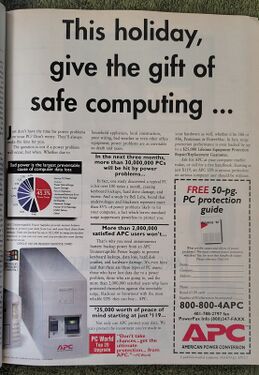 Full-page APC advertisement from PC Magazine, December 6, 1994.
 -
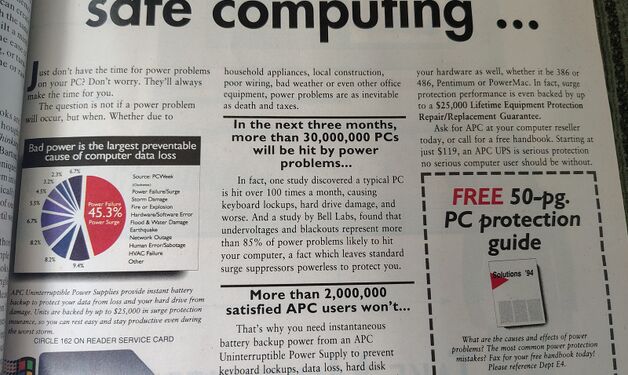 Advertisement detail showing the APC Back-UPS 400 and key marketing claims.
 -
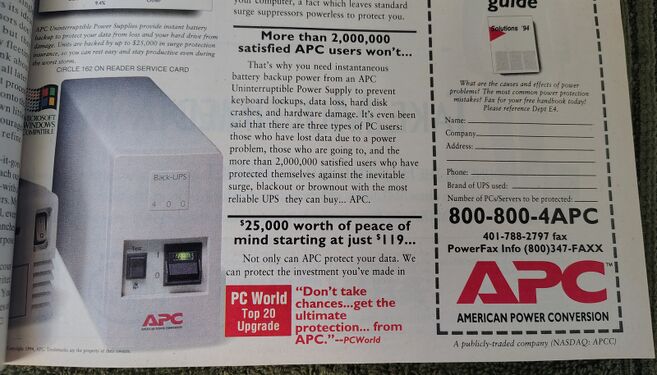 Mail-in offer for APC's free PC Protection Guide.


See also
July 1995
Perfect Dream Machine UPS Recommendation
PC Magazine's July 1995 Perfect Computer Comparison Guide included an uninterruptible power supply (UPS) as part of its recommended "Perfect Dream Machine" desktop computer configuration.
The guide specified a:
450-va UPS
and advised readers to:
Get one with a volt-ampere (VA) rating that's about a third larger than the combined wattage of your system unit and monitor.
The recommendation illustrates the growing importance of power-protection equipment during the mid-1990s personal-computing era. By 1995, PC Magazine considered a UPS a desirable component of a premium desktop PC configuration alongside the monitor, storage, networking, and multimedia components.
The accompanying illustration appears to be a stylized generic UPS rather than an identifiable commercial product. No manufacturer or model number is specified.
-
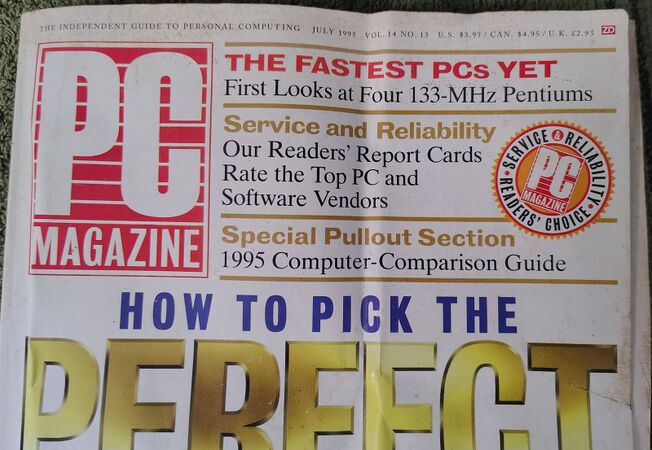 Cover of the July 1995 issue of PC Magazine featuring the Perfect Computer Comparison Guide.
 -
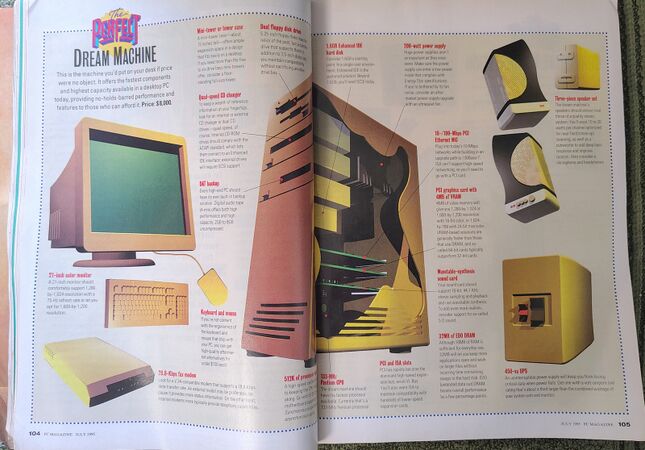 The "Perfect Dream Machine" configuration including a recommended 450 VA UPS.
 -
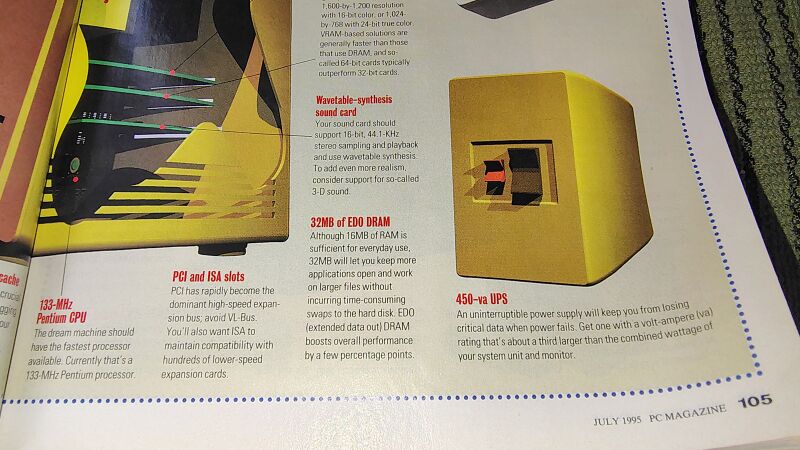 Detail showing the UPS recommendation and sizing guidance.


See also
Entry-Level System SOHO Upgrade
PC Magazine's July 1995 Perfect Computer Comparison Guide also discussed how an entry-level personal computer could be expanded into a Small Office / Home Office (SOHO) system.
Among the recommended upgrades was an:
Uninterruptible power supply
The recommendation appeared alongside other business-oriented upgrades including additional memory, higher-quality speakers, a telephone board, backup hardware, and productivity software.
The inclusion of a UPS within the SOHO upgrade recommendations suggests that PC Magazine viewed power protection as especially important in business and office environments where data loss and operational interruptions could have greater consequences.
-
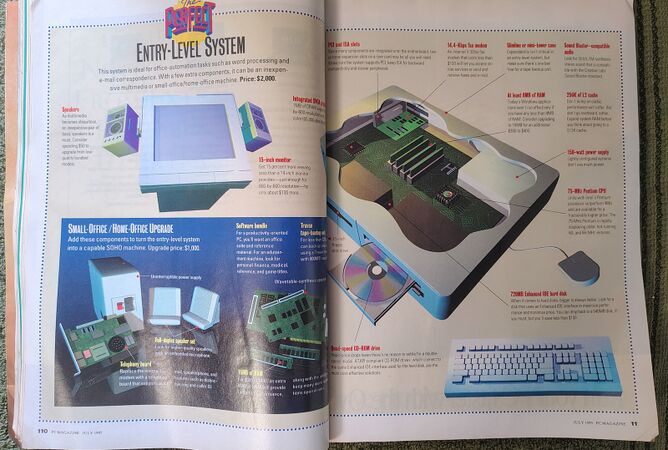 PC Magazine's July 1995 Entry-Level System showing recommended Small Office / Home Office upgrades.
 -
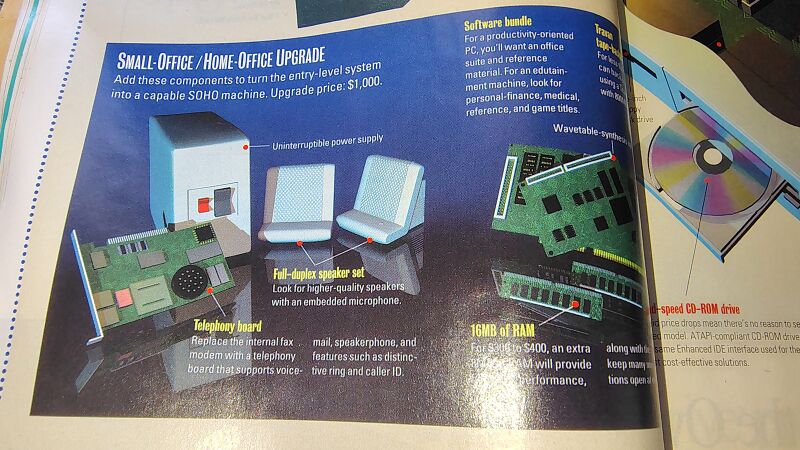 Detail of the SOHO upgrade recommendations including an uninterruptible power supply (UPS).


See also
Perfect File Server UPS Recommendation
PC Magazine's July 1995 Perfect Computer Comparison Guide also included an uninterruptible power supply (UPS) as a recommended component of its "Perfect File Server" configuration.
The guide specified a:
1,000- to 1,500-va UPS
and advised readers that:
An uninterruptible power supply is a must. Get one with a volt-ampere (va) rating that is about one-third greater than the combined wattage of the server and CRT as a minimum; larger capacities will give you a longer runtime.
Unlike the desktop-oriented "Perfect Dream Machine" recommendation, which specified a 450 VA UPS, the file-server configuration called for substantially larger backup-power capacity. The recommendation reflects the increasing importance of continuous operation, fault tolerance, and data protection in networked business environments during the mid-1990s.
The article treated a UPS as an essential component rather than an optional accessory, placing it alongside enterprise-oriented features such as multiple SCSI hard disks, DAT backup hardware, EISA/PCI expansion capability, and lockable front panels.
The accompanying illustration depicts a stylized generic UPS positioned adjacent to the file server. No manufacturer or model number is identified.
-
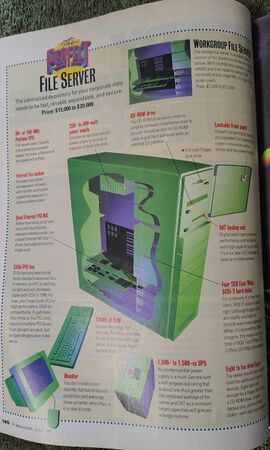 PC Magazine's July 1995 "Perfect File Server" configuration showing recommended server hardware and peripherals.
 -
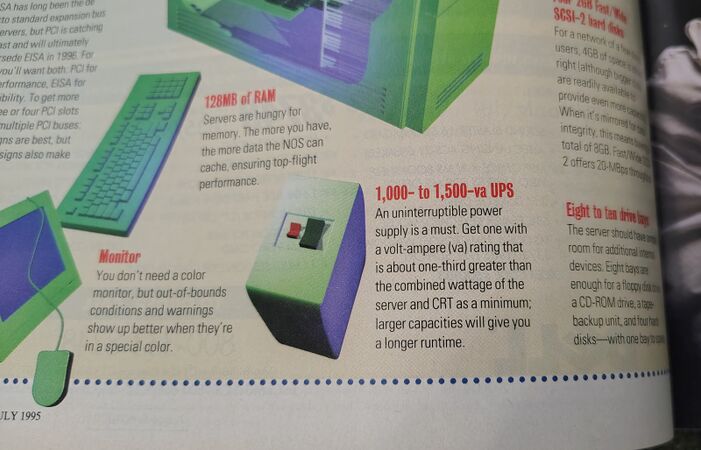 Detail showing the recommended 1,000- to 1,500-VA UPS and associated sizing guidance.


See also
Perfect Application Server UPS Recommendation
PC Magazine's July 1995 Perfect Computer Comparison Guide also included an uninterruptible power supply (UPS) as a required component of its recommended "Perfect Application Server" configuration.
The guide specified a:
1,000- to 1,500-va UPS
and advised readers that:
If your server shuts down unexpectedly, it spells disaster for your data. An uninterruptible power supply (UPS) is a must. You'll need one with a volt-ampere rating that is at least a third larger than the combined wattage of the server and CRT, and bigger is better.
The application-server recommendation closely mirrored the power-protection guidance provided for the file-server configuration. However, the application-server article placed greater emphasis on data integrity and fault tolerance, warning that an unexpected shutdown could result in data loss.
PC Magazine described the recommended application server as supporting mission-critical database applications and requiring "high performance plus bulletproof fault tolerance." The complete system carried an estimated price of approximately $40,000, making it the most expensive system configuration identified within the July 1995 guide.
The recommendation demonstrates that by 1995, UPS equipment had become an expected component of professional server deployments rather than an optional accessory. PC Magazine treated backup power as a fundamental element of application-server design alongside redundant power supplies, ECC memory, RAID storage, DAT backup hardware, and multiple Pentium processors.
The accompanying illustration depicts a stylized generic UPS adjacent to the server chassis. No manufacturer or model number is identified.
-
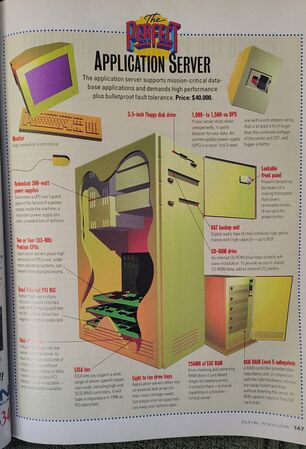 PC Magazine's July 1995 "Perfect Application Server" configuration showing a recommended 1,000- to 1,500-VA UPS.
 -
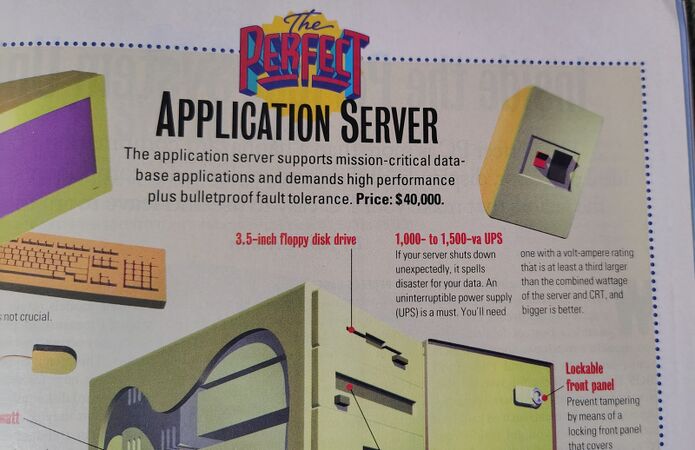 Detail of the application-server UPS recommendation and sizing guidance.


See also
December 5, 2000
APC Symmetra RM
A full-page APC advertisement published in the December 5, 2000 issue of PC Magazine promoted the newly introduced Symmetra RM rack-mount uninterruptible power supply (UPS).
The advertisement described the Symmetra RM as:
The first N+1 rack-mountable Power Array with all the reliability of Symmetra's patented redundancy and scalability.
Features highlighted in the advertisement included:
- Standard 19-inch rack mounting
- N+1 power redundancy
- User-replaceable and hot-swappable modules
- Integrated Web/SNMP management
- Scalable power capacity up to 6 kVA
- LCD and LED status display
- Network operating system compatibility
The advertisement also promoted a mail-in offer to enter a drawing for a free Symmetra RM system and directed readers to APC promotional websites and telephone sales channels.
-
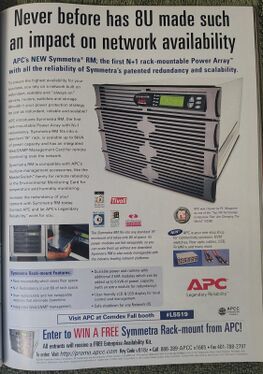 Full-page APC Symmetra RM advertisement from PC Magazine, December 5, 2000.
 -
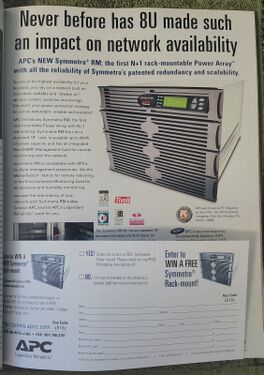 Advertisement detail highlighting Symmetra RM features and design.
 -
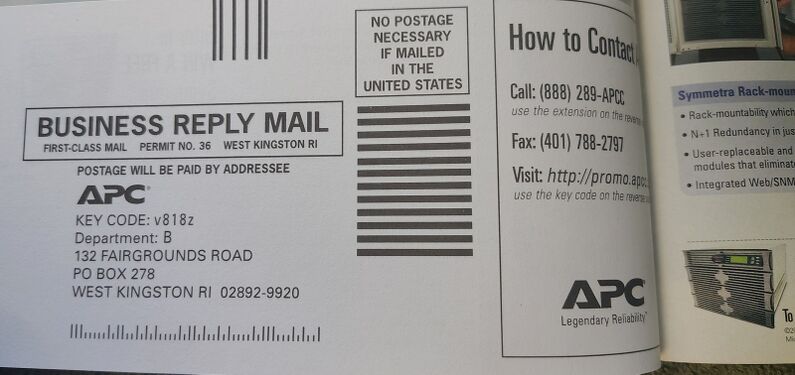 Business reply card included with the Symmetra RM advertisement.


See also
Compaq Pro UPS 500
A Compaq advertisement published in the December 5, 2000 issue of PC Magazine listed the Compaq Pro UPS 500 at a retail price of $149.
The advertisement described the unit as:
Protect your equipment and data from damage due to power surges, spikes, and outages.
-
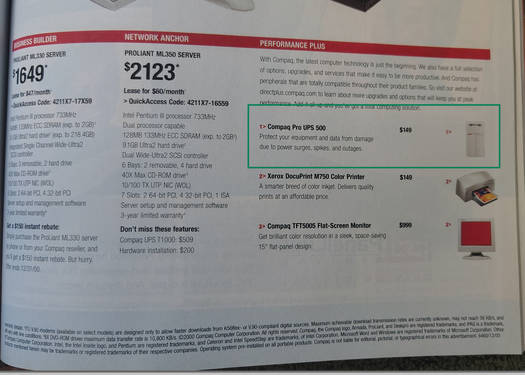 Compaq advertisement from PC Magazine, December 5, 2000.
 -
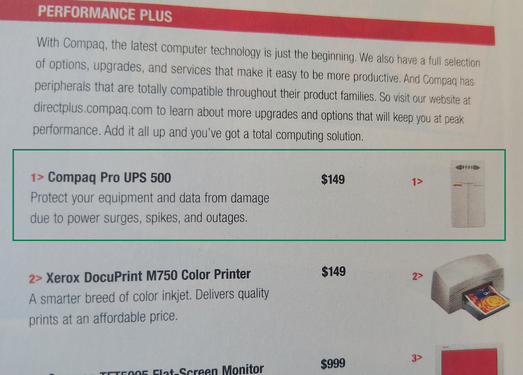 Detail showing the Compaq Pro UPS 500 listing.

