APC SurgeArrest Professional PRO7 (Z96030204796): Difference between revisions
No edit summary |
|||
| Line 179: | Line 179: | ||
== Teardown == | == Teardown == | ||
The enclosure is secured using multiple Phillips-head screws and can be opened non-destructively for examination. | |||
The | Internal construction closely matches the archive's 1994 APC PRO7 specimen. The documented example utilizes suppression board 640-0321 REV 2 carrying a ©1993 American Power Conversion copyright notice. | ||
The suppression board layout, outlet-contact assembly, enclosure construction, and internal wiring arrangement appear substantially identical to those documented in the archive's 1994 specimen. No significant design changes were observed during preliminary examination. | |||
Power distribution is accomplished through brass outlet-contact assemblies and stamped conductors running the length of the enclosure. The outlet structure is supported by molded barriers and reinforcement features integrated into the enclosure. | |||
The cord-entry section incorporates the power switch, status-indicator circuitry, and suppression-board assembly. Internal wiring remains simple and robust, with heavy-duty 14 AWG conductors supplying the outlet assembly. | |||
No molded internal date wheels were observed. This is consistent with the archive's 1994 specimen. The earliest documented PRO7 currently known to incorporate internal date wheels remains the August 1999 example. | |||
The documented example provides strong evidence that APC continued manufacturing the original ©1993 suppression-board design, revision 640-0321 REV 2, through at least 1996 production. | |||
<gallery mode="packed" heights="250"> | <gallery mode="packed" heights="250"> | ||
File:surge_APC_Pro7_Z96030204796_teardown_open_01.jpg|Internal construction following removal of the enclosure cover. | File:surge_APC_Pro7_Z96030204796_teardown_open_01.jpg|Internal construction following removal of the enclosure cover. | ||
File:surge_APC_Pro7_Z96030204796_teardown_toppanel_left_01.jpg|Upper enclosure details showing molded outlet barriers and structural reinforcement features. | File:surge_APC_Pro7_Z96030204796_teardown_toppanel_left_01.jpg|Upper enclosure details showing molded outlet barriers and structural reinforcement features. | ||
File:surge_APC_Pro7_Z96030204796_teardown_toppanel_right_01.jpg|Upper-housing details and molded outlet barriers. | |||
File:surge_APC_Pro7_Z96030204796_teardown_bottompanel_leftside_01.jpg|Suppression board 640-0321 REV 2 and outlet-contact assembly. | |||
File:surge_APC_Pro7_Z96030204796_teardown_cordentry_detail_01.jpg|Cord-entry area showing power-switch assembly and internal wiring. | |||
</gallery> | </gallery> | ||
== Comparison Notes == | == Comparison Notes == | ||
Revision as of 15:12, 9 October 2026
The APC SurgeArrest Professional PRO7 documented in this article was manufactured in 1996 and represents an early generation of APC's Professional SurgeArrest product family. The unit retains the same early Professional SurgeArrest branding style observed on the archive's 1994 example and appears to utilize the same ©1993 suppression-board generation.
This specimen helps bridge the gap between the earliest documented 1994 PRO7 and the later 1998 example that introduced APC's ©1996 suppression-board revision.

Overview
The APC SurgeArrest Professional PRO7 was APC's premium consumer surge-protection product during the 1990s. The series combined multiple grounded outlets, status indicators, site-wiring diagnostics, and metal-oxide-varistor (MOV) surge suppression into a product intended for personal computers, peripherals, and office equipment.
The documented example is notable because it preserves APC's early Professional SurgeArrest branding and appears to remain closely related to the archive's 1994 specimen despite being manufactured approximately two years later.
Historical Context
The documented 1996 example falls between the earliest documented 1994 PRO7 and the archive's first documented ©1996 suppression-board example manufactured in 1998.
The unit therefore provides an opportunity to examine how long APC continued producing products based upon the original ©1993 suppression-board generation before introducing later revisions. The documented example also retains APC's earlier Professional SurgeArrest logo design and product markings, which differ from the branding used on later examples in the archive.
As with other early PRO7 units, this specimen was manufactured during the period covered by APC's SurgeArrest recall program.
During the mid-1990s, many personal computers incorporated dial-up modems connected directly to telephone lines. While surge protectors such as the PRO7 provided protection against AC power-line disturbances, systems lacking telephone-line protection remained vulnerable to lightning-induced surges entering through modem connections.
APC offered related Professional SurgeArrest variants incorporating telephone and network-line protection. Contemporary advertisements indicate that such features commanded a significant price premium, illustrating the growing importance of modem and Internet connectivity during the period.
Documented Example
- OldSurge ID: OS-0023
- Manufacturer: APC
- Product Family: APC SurgeArrest Professional
- Model: PRO7
- Serial Number: Z96030204796
- Manufacturing Date: 1996
- PCB Revision: ©1993 (preliminary examination)
Specifications
Short introductory paragraph explaining what makes the specifications noteworthy.
- Manufacturer: APC (American Power Conversion) APC
- Product Family: APC SurgeArrest Professional
- Model: Pro7
- Device Type: Surge Protectors
- Country of Origin: China
- Electrical Rating: 15A, 120VAC, 50/60Hz
- TVSS Rating:
- L-N (Line to Neutral): 330V
- L-G (Line to Ground): 330V
- N-G (Neutral to Ground): 330V
- Outlets: 7
- Protection: Power (AC)
- Length: Approximately 10.25 in (26.0 cm)
- Width: Approximately 4.25 in (10.8 cm)
- Height: Approximately 1.75 in (4.4 cm)
- Weight: 1 lb 14.7 oz (842 g)
- Power Cord Length: Approximately 6 ft
- Plug Type: NEMA 5-15P
- Plug Style: Straight Blade
- Cord Type: SJT
- Conductors: 3
- Conductor Size: 14 AWG
- UL File Number (Cord): E135710
- CSA File Number (Cord): LL152727
- Cord Manufacturer: Bon-Eagle
Notable Characteristics
- Manufactured in 1996.
- Early Professional SurgeArrest branding style.
- Utilizes the ©1993 suppression-board generation.
- Retains "American Power Conversion" branding beneath the logo.
- Protection Working and Site Wiring Fault indicators.
- Transitional example between the archive's 1994 and 1998 documented PRO7 generations.
- Straight-blade unbranded attachment plug identical to the 1994 specimen.
- Dimensions closely match the archive's 1994 PRO7 example.
Weight
The documented APC PRO7 weighs approximately 1 pound 14.7 ounces (842 grams).
The measured weight is nearly identical to the archive's 1994 PRO7 specimen, which weighed approximately 1 pound 14.8 ounces. The minimal difference suggests that APC had not yet made substantial changes to the enclosure, cord assembly, or surge-suppression architecture between the two documented examples.
The weight also places the 1996 specimen among the heavier members of the PRO7 family documented by the archive, preceding the gradual weight reductions observed in later generations.

Physical Characteristics
The documented example utilizes APC's early Professional SurgeArrest enclosure design featuring a rounded upper housing and seven grounded receptacles arranged in a single row.
The front of the enclosure incorporates APC's early Professional SurgeArrest logo consisting of blue "PROFESSIONAL" branding above the larger "SURGE ARREST" mark and the "American Power Conversion" company name below.
Two status indicators are present. A green "Protection Working" indicator provides confirmation that surge-protection circuitry remains active, while a red "Site Wiring Fault" indicator is intended to identify common electrical wiring problems.
The rocker power switch matches the style used on the archive's 1994 example. Examination of both units suggests that the molded "I" and "O" switch-position markings may have been produced as unpainted raised features rather than white-filled markings that later faded from use.
The enclosure measures approximately 10.25 inches long, 4.25 inches wide, and 1.75 inches tall.
The documented example retains the early rounded-top Professional SurgeArrest enclosure design previously observed on the archive's 1994 specimen. The housing combines a curved upper section with a rectangular outlet assembly containing seven grounded receptacles arranged in a single row.
Like the 1994 example, the unit uses a straight-blade grounding attachment plug without APC branding. Later documented examples transitioned to different plug styles and APC-branded attachment plugs.
The underside incorporates two molded keyhole mounting slots that permit wall or under-desk installation.
The mounting arrangement appears unchanged from the archive's 1994 specimen.
The attached power cord utilizes heavy-duty SJT construction with three 14 AWG conductors. Cord markings identify the cord manufacturer as Bon-Eagle and indicate both UL and CSA approval.
The straight-blade NEMA 5-15P attachment plug is unbranded and closely matches the design documented on the archive's 1994 PRO7 specimen. Later documented PRO7 examples transitioned to APC-branded attachment plugs and revised plug designs.
Photographs
-
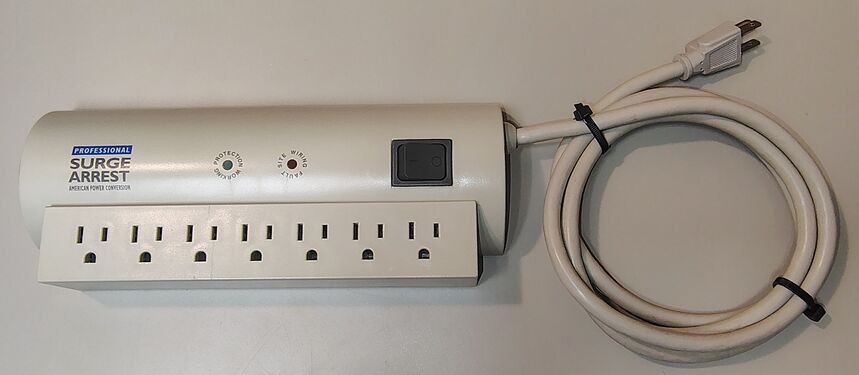 Overall view of the documented 1996 APC SurgeArrest Professional PRO7.
 -
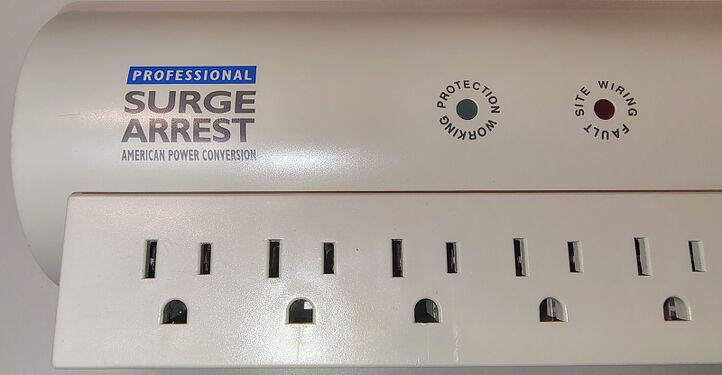 Early Professional SurgeArrest branding and American Power Conversion logo.
 -
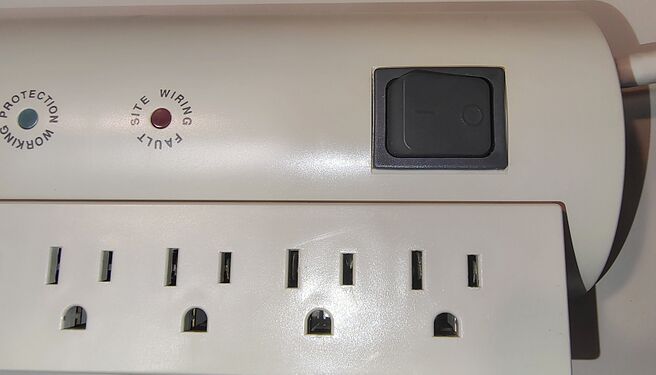 Power switch and indicator assembly showing Protection Working and Site Wiring Fault indicators.
 -
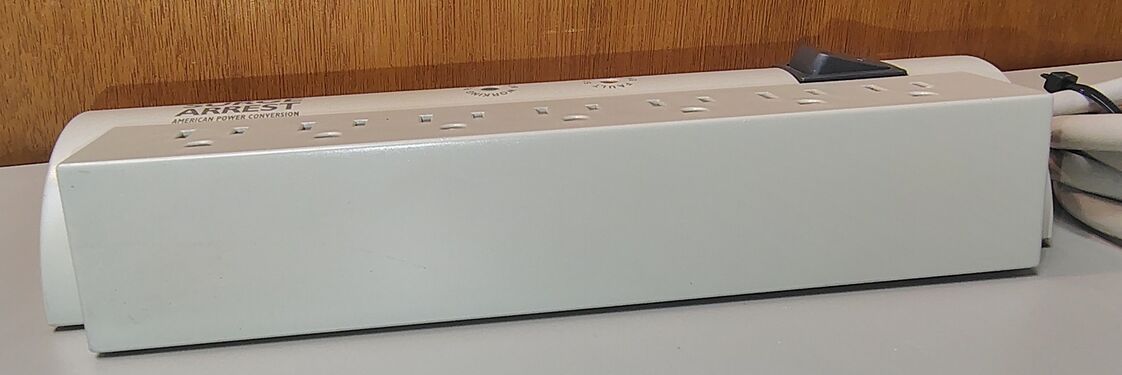 Side profile showing the flat-sided outlet section and overall enclosure design.
 -
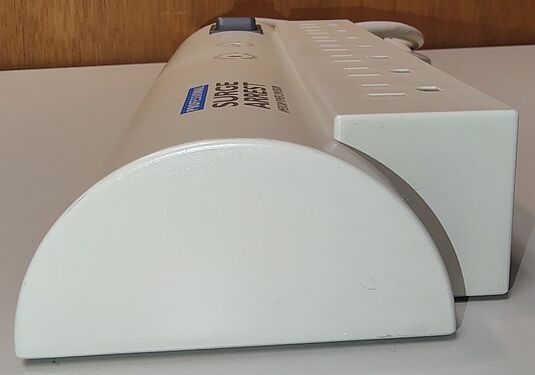 Rounded end profile characteristic of early Professional SurgeArrest models.
 -
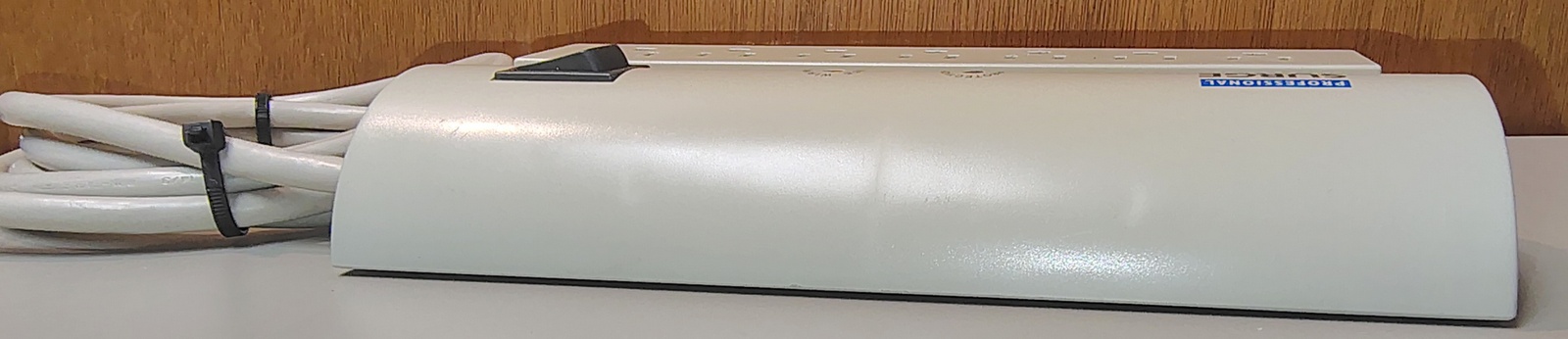 Opposite-side profile showing the rounded upper housing and power-cord routing.
 -
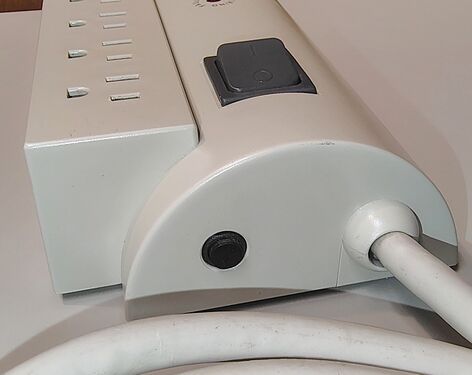 Cord-entry end showing strain relief and enclosure construction.
 -
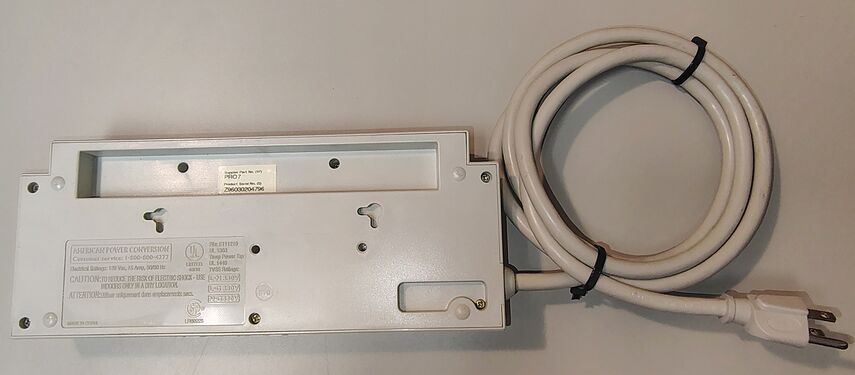 Underside overview showing mounting provisions, serial-number label, and regulatory markings.
 -
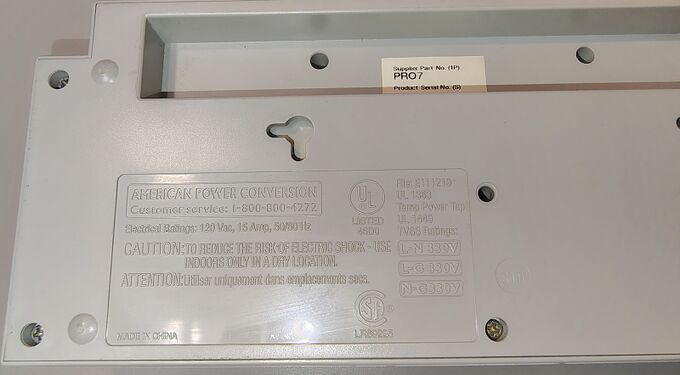 Underside ratings and certification markings.
 -
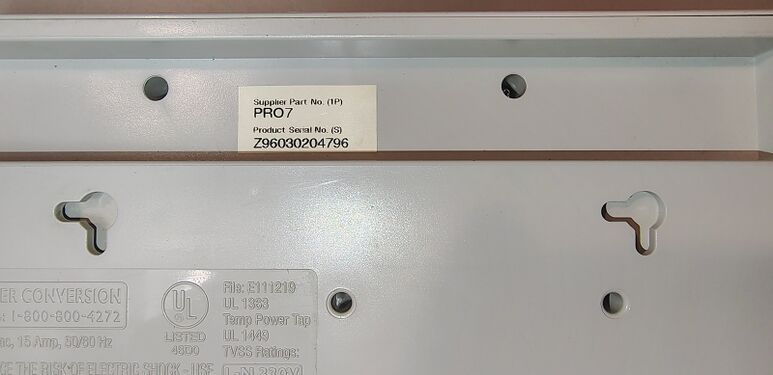 Serial-number label identifying the documented PRO7 specimen.
 -
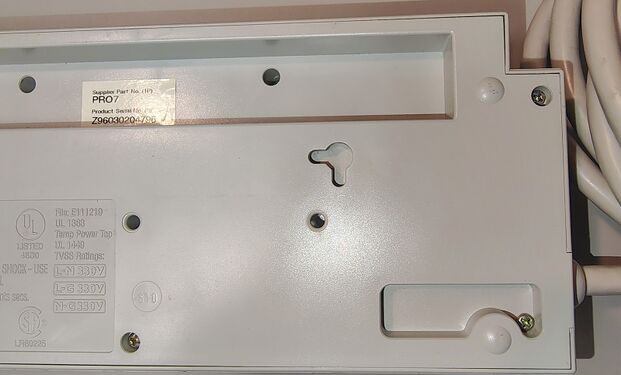 Cord-entry end showing power-cord strain relief and enclosure details.
 -
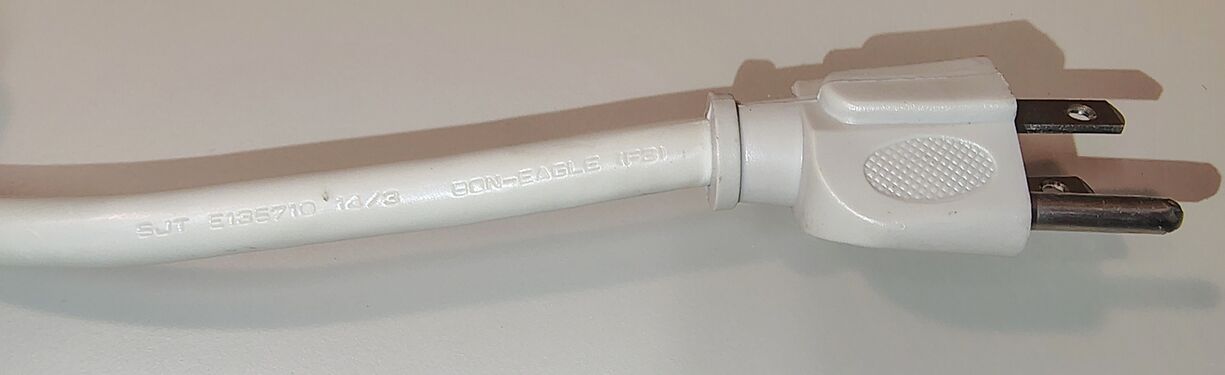 Straight-blade grounding attachment plug and power-cord assembly.
 -
 Cord markings showing Bon-Eagle manufacturing information and SJT 14/3 construction.
 -
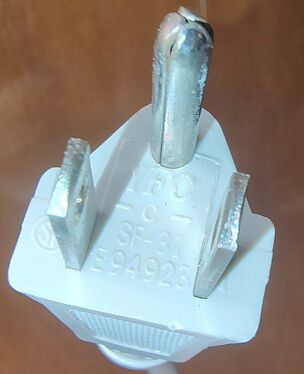 Detail view of the unbranded NEMA 5-15P attachment plug.


Date Codes
The underside serial-number label identifies the unit as Supplier Part No. PRO7 and carries serial number Z96030204796.
The serial-number format is consistent with the archive's earliest documented PRO7 specimens and provides evidence of APC's manufacturing-date coding practices for the entire production run of the Pro7 series.
Condition Upon Acquisition
The documented example was acquired in complete and apparently functional condition. Light accumulated dust and minor cosmetic wear were present, consistent with normal long-term use and storage.
The enclosure remained structurally intact with no evidence of cracking, melting, or significant physical damage. Labeling and product markings remained clear and legible, including the early Professional SurgeArrest branding.
The power cord, attachment plug, outlets, and power switch appeared intact at the time of acquisition.

Functional Testing
The documented example was connected to AC power for basic operational testing.
The rocker switch successfully controlled power to the outlet assembly. When the unit was energized, the green Protection Working indicator illuminated normally, indicating that surge-suppression circuitry remained active.
The red Site Wiring Fault indicator remained extinguished during testing, indicating that no wiring fault was detected at the test receptacle.
Testing with a receptacle tester confirmed correct hot, neutral, and ground wiring at the outlet assembly. No open-ground, open-neutral, reversed-polarity, or related wiring faults were detected.
No operational abnormalities were observed during testing.
-
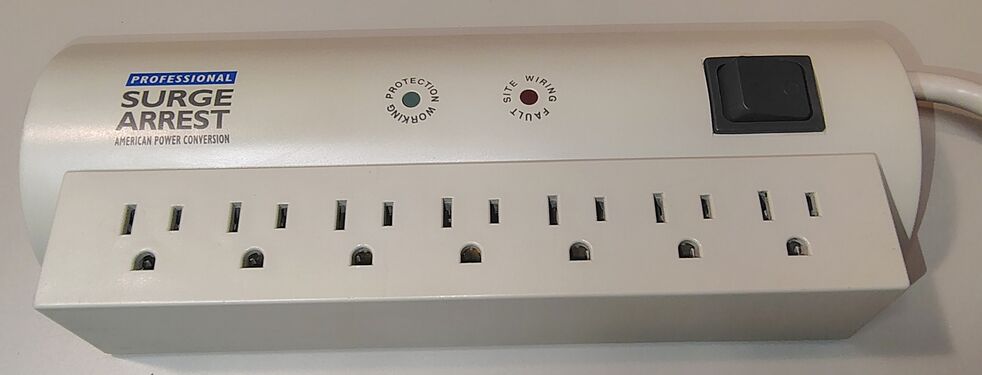 Connected to AC power with the rocker switch in the OFF position.
 -
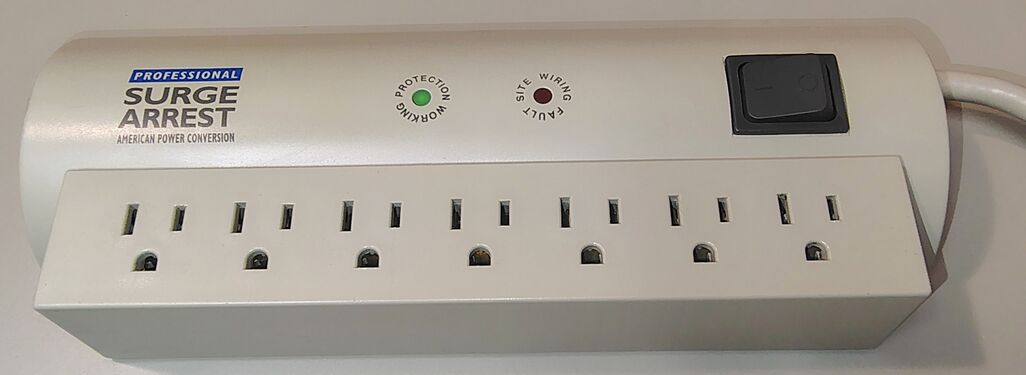 Protection Working indicator illuminated with the rocker switch in the ON position.
 -
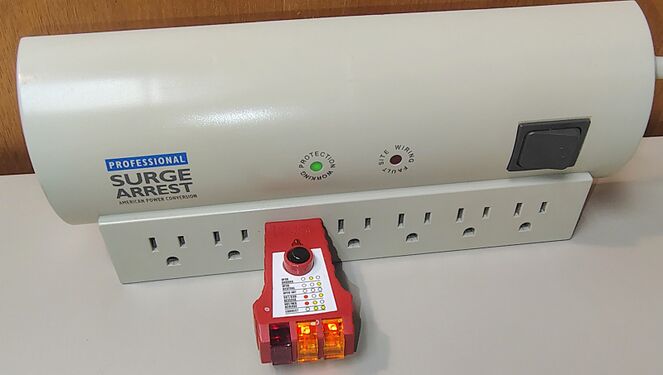 Receptacle tester indicating correct wiring and grounding.


Teardown
The enclosure is secured using multiple Phillips-head screws and can be opened non-destructively for examination.
Internal construction closely matches the archive's 1994 APC PRO7 specimen. The documented example utilizes suppression board 640-0321 REV 2 carrying a ©1993 American Power Conversion copyright notice.
The suppression board layout, outlet-contact assembly, enclosure construction, and internal wiring arrangement appear substantially identical to those documented in the archive's 1994 specimen. No significant design changes were observed during preliminary examination.
Power distribution is accomplished through brass outlet-contact assemblies and stamped conductors running the length of the enclosure. The outlet structure is supported by molded barriers and reinforcement features integrated into the enclosure.
The cord-entry section incorporates the power switch, status-indicator circuitry, and suppression-board assembly. Internal wiring remains simple and robust, with heavy-duty 14 AWG conductors supplying the outlet assembly.
No molded internal date wheels were observed. This is consistent with the archive's 1994 specimen. The earliest documented PRO7 currently known to incorporate internal date wheels remains the August 1999 example.
The documented example provides strong evidence that APC continued manufacturing the original ©1993 suppression-board design, revision 640-0321 REV 2, through at least 1996 production.
-
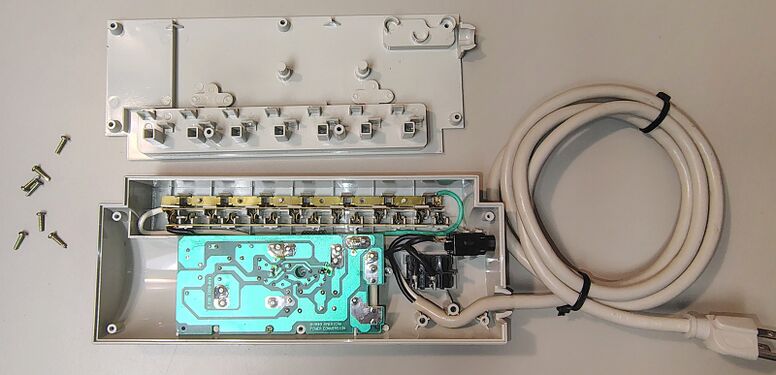 Internal construction following removal of the enclosure cover.
 -
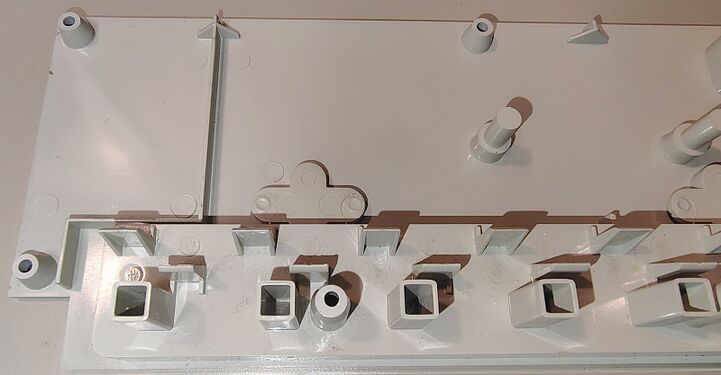 Upper enclosure details showing molded outlet barriers and structural reinforcement features.
 -
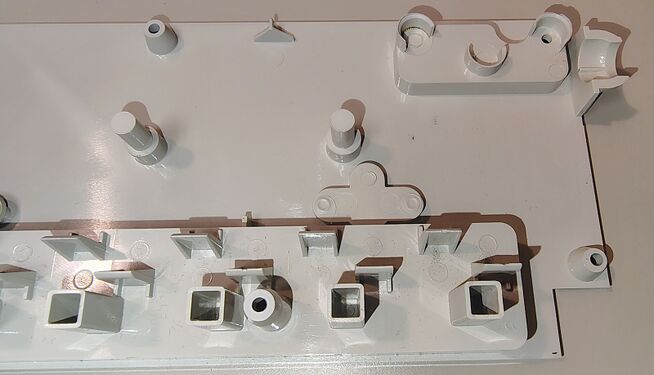 Upper-housing details and molded outlet barriers.
 -
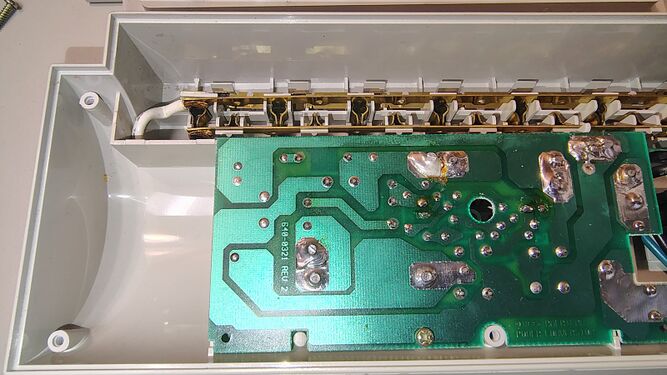 Suppression board 640-0321 REV 2 and outlet-contact assembly.
 -
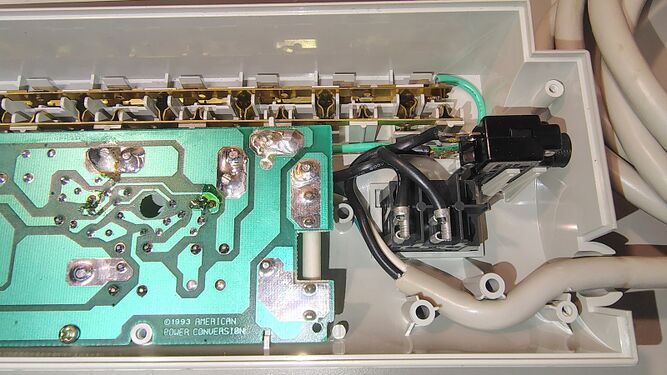 Cord-entry area showing power-switch assembly and internal wiring.


Comparison Notes
Comparison with the archive's 1996 specimen suggests that the raised switch-position markings were originally produced without contrasting paint fill and may represent normal factory appearance rather than wear-related loss.
The documented 1996 example establishes that APC continued manufacturing PRO7 units based upon the original ©1993 design generation for at least two years after the archive's earliest documented specimen.
This narrows the transition period between the original design and the later ©1996 suppression-board revision documented in the archive's 1998 specimen.
Recall Information
If applicable.
Historical References
Historical advertisements, archived manufacturer literature, patents, magazine references, archived web captures, and period specifications.

Notes
- Additional observations.
- Manufacturing details.
- Interesting findings.