APC SurgeArrest Professional PRO7 (Z94030204087): Difference between revisions
No edit summary |
|||
| Line 77: | Line 77: | ||
* Cord CSA File: LL95737 | * Cord CSA File: LL95737 | ||
* Cord Length: Approximately 6 ft | * Cord Length: Approximately 6 ft | ||
* ©1993 American Power Conversion | |||
* 614-0321 REV 2 | |||
== Physical Characteristics == | == Physical Characteristics == | ||
| Line 178: | Line 180: | ||
The overall internal layout combines discrete surge-suppression circuitry, filtering components, brass-contact power distribution, a dedicated rocker-switch assembly, and a separate indicator-light circuit. | The overall internal layout combines discrete surge-suppression circuitry, filtering components, brass-contact power distribution, a dedicated rocker-switch assembly, and a separate indicator-light circuit. | ||
Internal examination revealed a suppression board carrying a ©1993 American Power Conversion copyright marking and board number 614-0321 REV 2, making it the earliest suppression-board revision currently documented by the OldSurge Archive. | |||
The surge-suppression circuitry incorporates multiple metal-oxide varistors (MOVs), toroidal filtering inductors, indicator circuitry, protective components, and a cartridge fuse mounted on a dedicated printed-circuit board. | |||
Two large toroidal inductors are present and occupy a substantial portion of the suppression assembly. The filtering section appears significantly larger than that observed in some later documented APC PRO7 revisions. | |||
Power distribution is accomplished through full-length brass outlet-contact strips supported by molded outlet structures integrated into the enclosure. | |||
The internal construction combines surge-suppression circuitry, EMI/RFI filtering, site-wiring diagnostics, brass-contact power distribution, and a separate rocker-switch assembly within a relatively spacious enclosure. | |||
The documented example retains all major suppression and filtering components and showed no obvious evidence of catastrophic component failure, overheating, or prior repair during teardown. | |||
<gallery mode="packed" heights="250"> | <gallery mode="packed" heights="250"> | ||
| Line 187: | Line 201: | ||
File:surge_APC_Pro7_Z94030204087_teardown_boarddetail_01.jpg|Suppression components including filtering inductors, MOVs, and protection circuitry mounted on the ©1993 board. | File:surge_APC_Pro7_Z94030204087_teardown_boarddetail_01.jpg|Suppression components including filtering inductors, MOVs, and protection circuitry mounted on the ©1993 board. | ||
File:surge_APC_Pro7_Z94030204087_teardown_boarddetail_02.jpg|Additional view of suppression components and filtering circuitry on the ©1993 board. | File:surge_APC_Pro7_Z94030204087_teardown_boarddetail_02.jpg|Additional view of suppression components and filtering circuitry on the ©1993 board. | ||
File:surge_APC_Pro7_Z94030204087_teardown_boarddetail_03.jpg|Low-angle view of the ©1993 suppression board showing filtering inductors, suppression components, wiring, and outlet-contact strips. | |||
</gallery> | </gallery> | ||
== Construction == | == Construction == | ||
<br> | |||
The APC PRO7 utilizes a two-piece molded-plastic enclosure secured with Phillips-head screws. | |||
Power distribution is accomplished through full-length brass outlet-contact strips supported by molded outlet structures integrated into the enclosure. | |||
The | The documented example incorporates a dedicated suppression board, rocker-switch assembly, indicator-light circuitry, cartridge fuse, toroidal filtering inductors, metal-oxide varistors (MOVs), and discrete passive components. | ||
Internal examination confirmed the use of a ©1993 American Power Conversion suppression board identified as revision 614-0321 REV 2. | |||
The overall construction emphasizes heavy-duty power distribution, surge suppression, and EMI/RFI filtering while maintaining the characteristic seven-outlet APC SurgeArrest Professional layout. | |||
== Notes == | |||
Internal examination | * Earliest APC PRO7 currently documented by the OldSurge Archive. | ||
* Utilizes a straight-blade attachment plug rather than the right-angle plug used on later documented examples. | |||
* Features an early Professional SurgeArrest logo design. | |||
* Internal examination identified suppression-board revision 614-0321 REV 2. | |||
* Internal circuitry includes multiple MOVs, large toroidal inductors, and a cartridge fuse. | |||
* Despite being manufactured in 1994, the unit remained functional during testing. | |||
Revision as of 14:59, 3 October 2026
APC SurgeArrest Professional PRO7 (Z94030204087)
The APC SurgeArrest Professional PRO7 documented here bears serial number Z94030204087, indicating manufacture in 1994. The unit was manufactured in China and represents the earliest APC PRO7 specimen currently documented by the OldSurge Archive.
This example is particularly notable for its early branding variation, a suppression board carrying a ©1993 copyright notice, and its inclusion within the manufacturing period affected by the 2013 APC SurgeArrest recall.

Overview
| Manufacturer | APC (American Power Conversion) |
|---|---|
| Product Family | SurgeArrest Professional |
| Model | PRO7 |
| Serial Number | Z94030204087 |
| Manufacturing Year | 1994 |
| Country of Manufacture | China |
| Product Type | Surge Protector |
| AC Outlets | 7 |
| Recall Status | Included in APC SurgeArrest Recall (2013) |
Notable Characteristics
- Earliest APC PRO7 specimen currently documented by the OldSurge Archive.
- Manufactured in 1994.
- Includes a suppression board carrying a ©1993 copyright notice.
- Manufactured during the period covered by the APC SurgeArrest Recall (2013).
- Utilizes an early Professional SurgeArrest logo variation not observed on later documented PRO7 examples.
- Appears to utilize an earlier straight-blade attachment-plug design rather than the right-angle plug found on later documented specimens.
- Rocker-switch ON/OFF markings exhibit substantial wear.
- Manufactured in China.
Specifications
- Length: Approximately 10.25 in (26.0 cm)
- Width: Approximately 4.19 in (10.6 cm)
- Height:
- Approximately 1.69 in (4.3 cm) at the outlet section
- Approximately 1.75 in (4.4 cm) at the curved upper enclosure
- Electrical Rating: 120VAC, 15A, 50/60Hz
- Country of Manufacture: China
- UL File: E111219
- UL 1363 Temporary Power Tap Listed
- UL 1449 TVSS Listed
- TVSS Ratings:
- L-N 330V
- L-G 330V
- N-G 330V
- Plug Type: Grounded NEMA 5-15P
- Plug Style: Straight-blade
- Plug Model: SF-31
- Plug Manufacturer Marking: YFC
- Plug UL File: E94929
- Plug CSA File: LR62202
- Cord Type: SJT
- Cord Manufacturer: Bon-Eagle
- Cord UL File: E135710
- Cord Size: 16 AWG × 3 Conductors
- Cord CSA File: LL95737
- Cord Length: Approximately 6 ft
- ©1993 American Power Conversion
- 614-0321 REV 2
Physical Characteristics
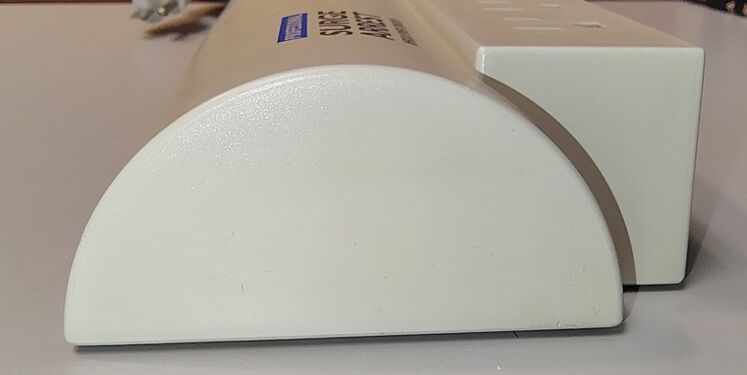
The APC PRO7 utilizes a two-section enclosure consisting of a rectangular lower outlet housing and a distinctive curved upper enclosure containing the switch, indicators, and surge-suppression circuitry.
The documented example retains the early Professional SurgeArrest logo design consisting of a blue PROFESSIONAL banner above SURGE ARREST branding with AMERICAN POWER CONVERSION printed beneath.
Two indicator lamps labeled Protection Working and Site Wiring Fault are positioned adjacent to the power switch.
The rocker switch remains present and operational, although the molded ON/OFF markings exhibit substantial wear from long-term service.
The underside incorporates two wall-mount keyhole slots and a recessed serial-number label identifying the unit as PRO7 serial number Z94030204087.
Unlike later documented APC PRO7 examples, the documented 1994 example utilizes different branding graphics and a straight-blade attachment plug rather than the right-angle plug design observed on later documented PRO7 units.
The enclosure incorporates TVSS identification markings and suppression ratings of 330 volts for line-to-neutral, line-to-ground, and neutral-to-ground protection modes.
A molded "943" marking is present on the underside of the enclosure. The significance of this marking has not been definitively established but may represent a mold identifier, production code, or manufacturing reference.
Weight
The documented example weighs approximately 1 lb 14.8 oz (873 g), including the attached power cord.
Despite being the earliest documented APC PRO7 currently preserved by the OldSurge Archive, the 1994 example is slightly lighter than the 1998 example while remaining substantially heavier than later documented PRO7 generations.

Photographs
-
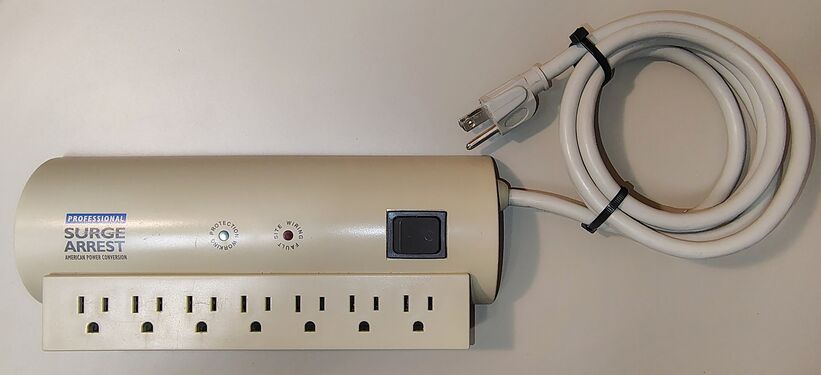 Overall view showing the seven-outlet layout, attached power cord, and early Professional SurgeArrest branding.
 -
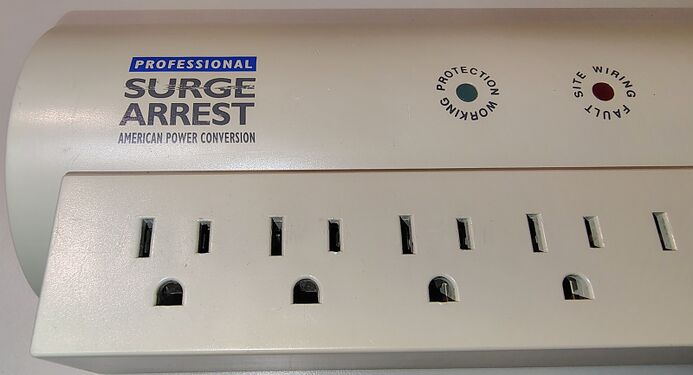 Early Professional SurgeArrest logo and indicator lights.
 -
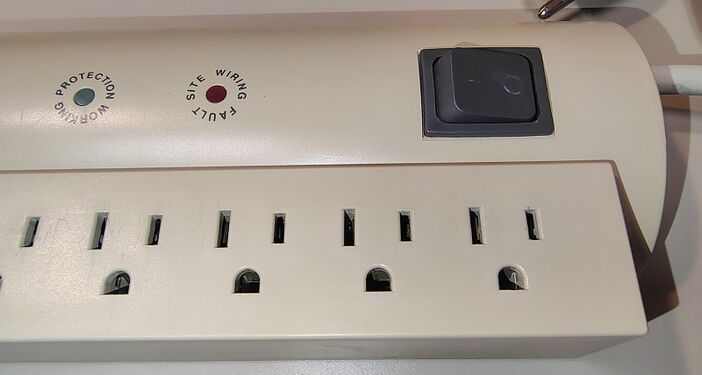 Power switch showing wear to the ON/OFF markings.
 -
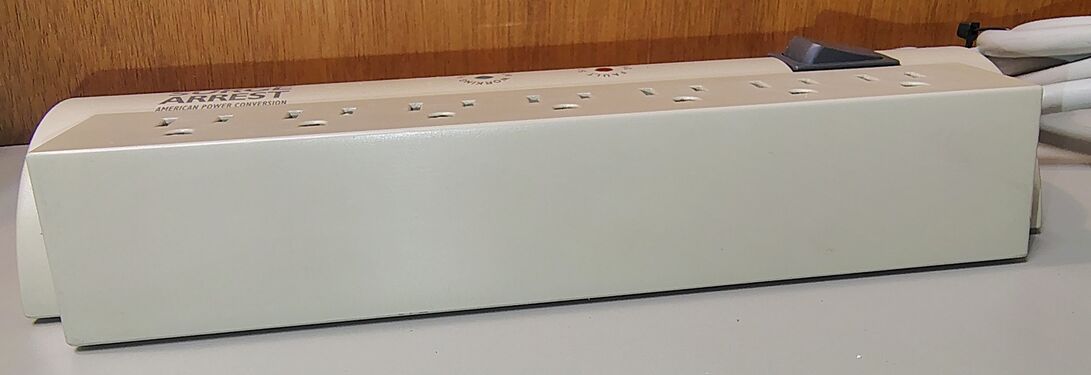 Side profile showing the seven-outlet section and rectangular lower enclosure.
 -
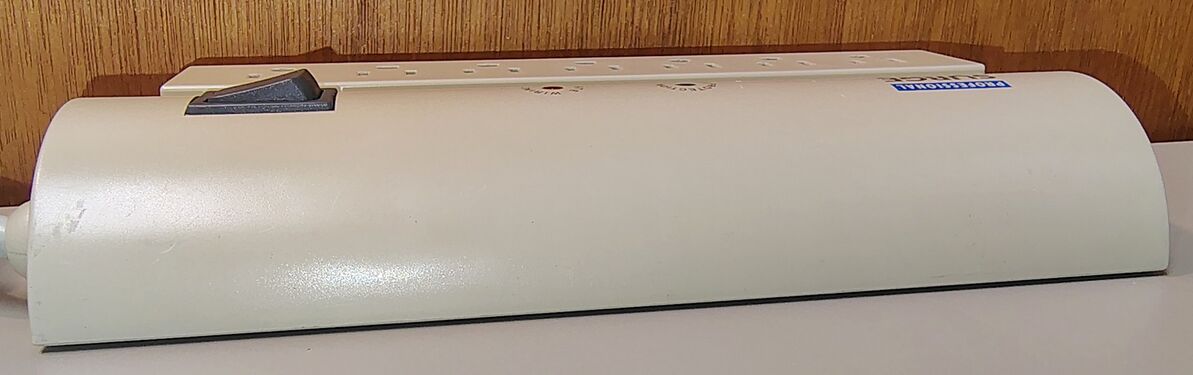 End view showing the distinctive curved upper enclosure of the early PRO7 design.
 -
 Side profile showing enclosure construction, outlet arrangement, and overall condition.
 -
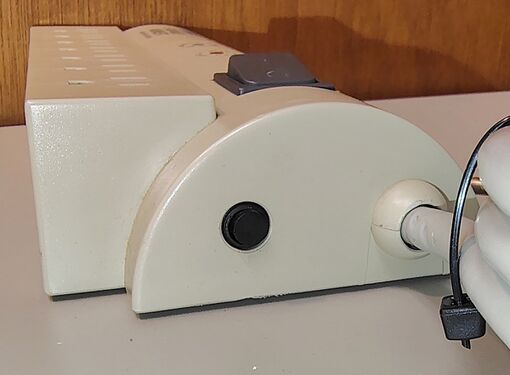 Cord-entry end showing strain relief, enclosure profile, and switch location.
 -
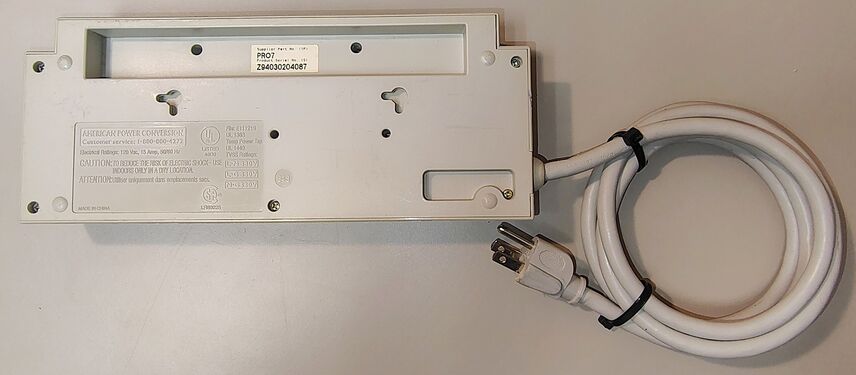 Underside showing product markings, wall-mount slots, enclosure hardware, and attached power cord.
 -
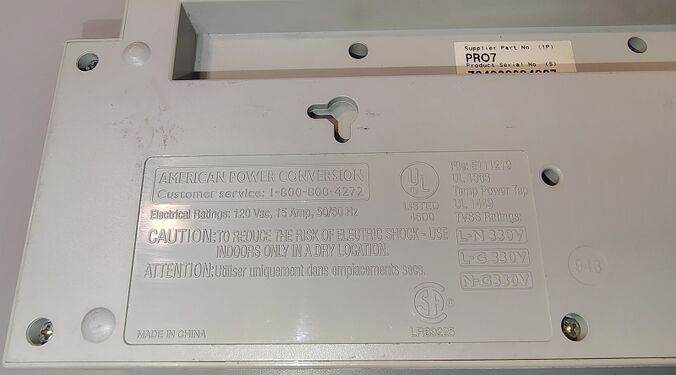 Model identification, safety markings, TVSS ratings, and serial-number label.
 -
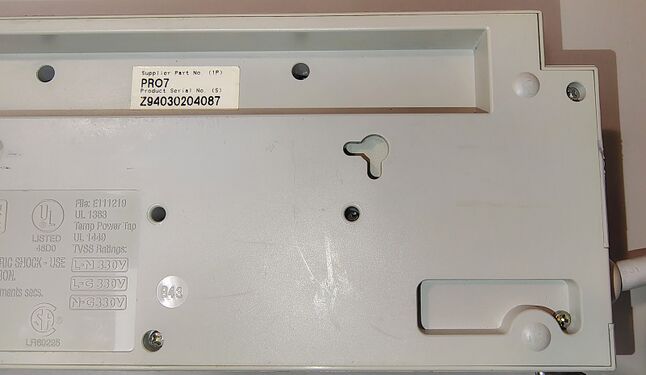 Cord-entry side of the underside showing mounting features, enclosure hardware, and molded markings.
 -
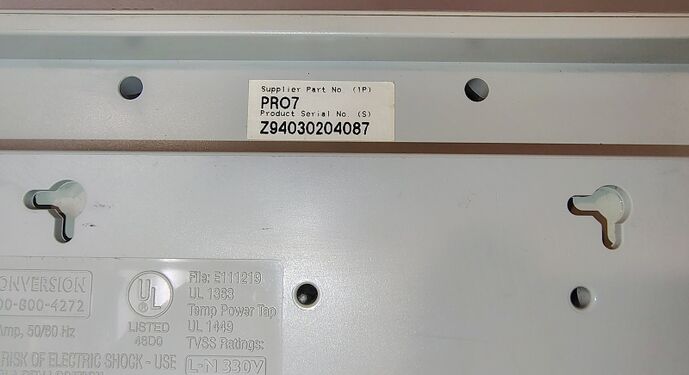 Serial-number label, wall-mount slots, and underside markings.
 -
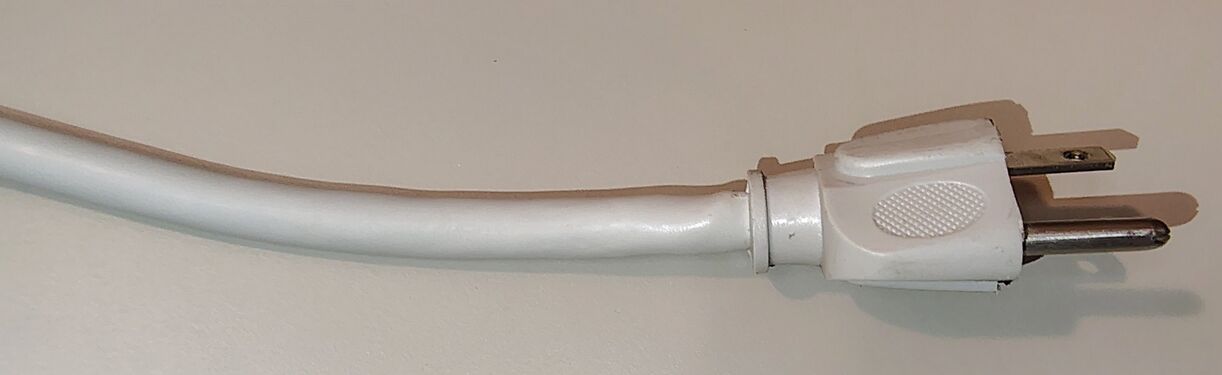 Straight-blade attachment plug and attached power cord.
 -
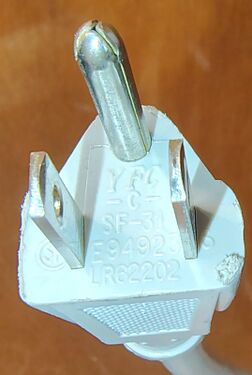 Straight-blade attachment plug showing approval markings and manufacturer identifiers.
 -
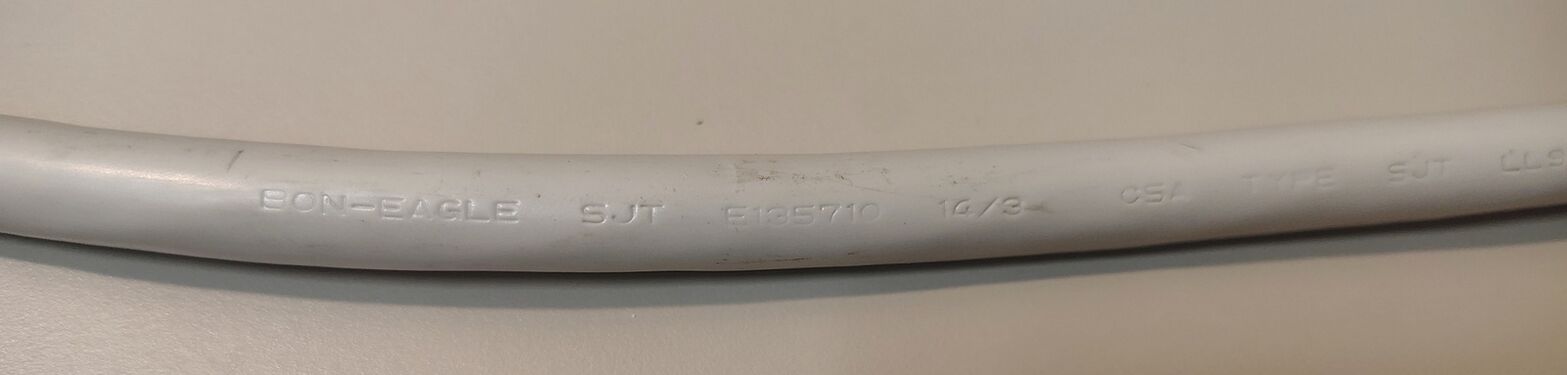 Power-cord markings showing manufacturer and construction information.
 -
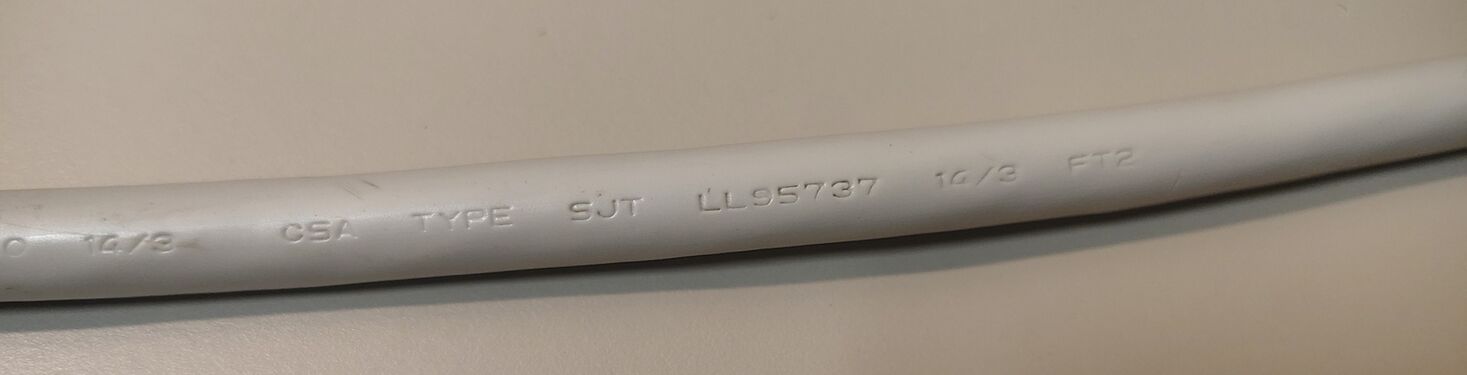 Additional power-cord markings showing CSA approvals and cable construction information.


Condition Upon Acquisition
This example exhibits cosmetic wear consistent with more than three decades of age and long-term service.
Accumulated dirt, minor discoloration, scratches, scuffs, and general handling wear were visible prior to cleaning and documentation. The rocker-switch ON/OFF markings exhibit noticeable wear and are among the most visibly worn markings observed on a documented APC PRO7.
No evidence of melting, cracking, deformation, overheating, or major physical damage was observed during external examination.
The unit was cleaned prior to detailed photography, testing, and teardown documentation.
-
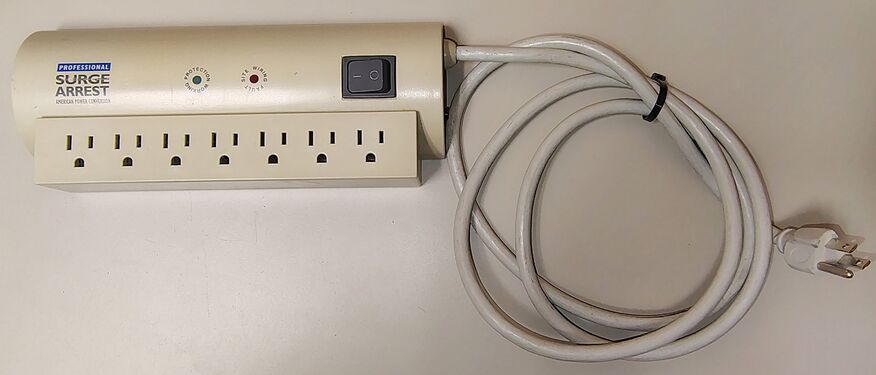 Condition upon acquisition prior to cleaning and documentation.

Functional Testing
The documented example was connected to utility power and evaluated for basic functionality.
When energized, the green Protection Working indicator illuminated, indicating that surge-protection circuitry remained connected and operational at the time of testing.
The Site Wiring Fault indicator remained extinguished during testing under normal operating conditions.
Testing with a receptacle tester confirmed correct hot, neutral, and ground wiring. No open ground, open neutral, reversed polarity, or other wiring faults were detected.
The rocker switch successfully controlled power to all outlets. When switched OFF, power was removed from the outlet bank and the Protection Working indicator extinguished.
The documented example passed basic functional testing and remained operational at the time of documentation.
-
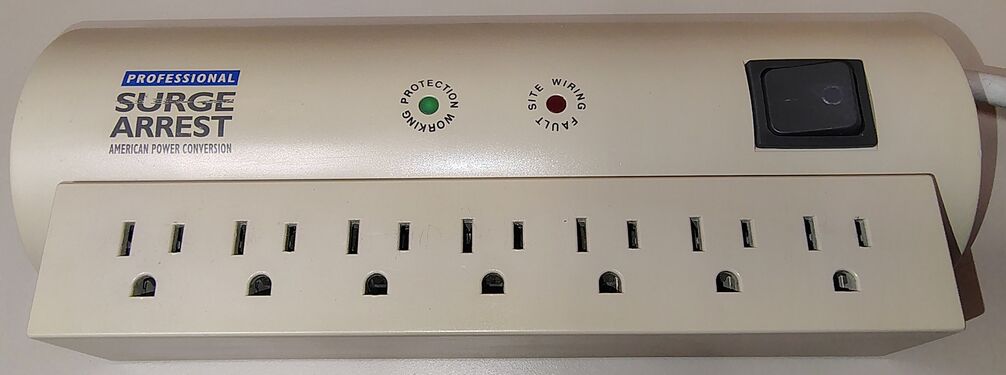 Protection Working indicator illuminated during testing.
 -
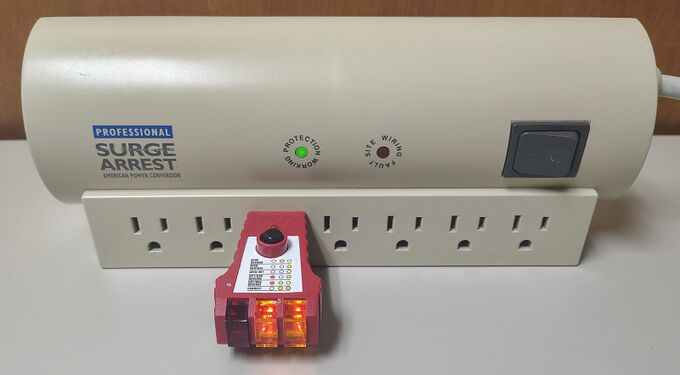 Outlet tester indicating correct wiring and grounding.
 -
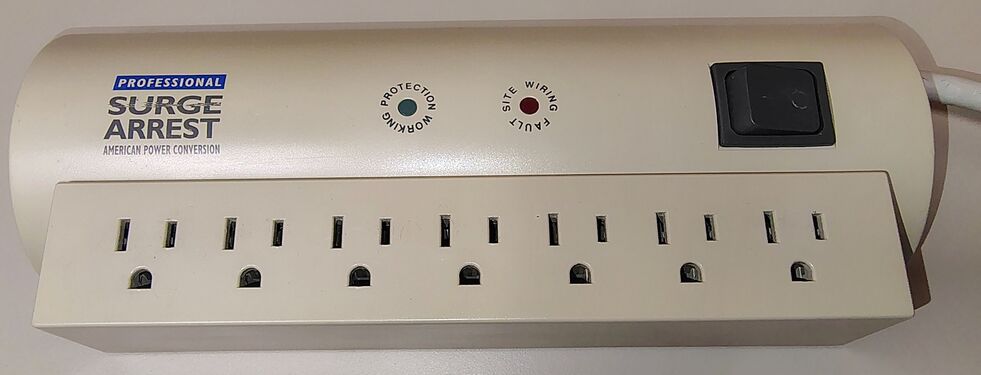 Unit connected to power with the rocker switch in the OFF position.


Teardown
Teardown commenced following completion of external documentation, measurement, photography, and functional testing.
Removal of the enclosure screws allowed the upper housing section to be separated from the base, revealing the internal outlet assembly, suppression circuitry, rocker-switch assembly, and wiring.
The internal printed-circuit board carries a ©1993 American Power Conversion copyright marking, making this the earliest suppression-board revision currently documented by the OldSurge Archive.
Internal examination revealed a suppression board carrying a ©1993 American Power Conversion copyright marking, making it the earliest suppression-board revision currently documented by the OldSurge Archive.
The surge-suppression circuitry incorporates multiple metal-oxide varistors (MOVs), filtering inductors, resistors, indicator circuitry, and a fuse mounted on a dedicated printed-circuit board.
Two large toroidal inductors are present and appear substantially larger than those observed in some later APC PRO7 revisions documented by the archive.
Power is distributed through full-length brass outlet-contact strips supported by molded outlet structures integrated into the enclosure.
The overall internal layout combines discrete surge-suppression circuitry, filtering components, brass-contact power distribution, a dedicated rocker-switch assembly, and a separate indicator-light circuit.
Internal examination revealed a suppression board carrying a ©1993 American Power Conversion copyright marking and board number 614-0321 REV 2, making it the earliest suppression-board revision currently documented by the OldSurge Archive.
The surge-suppression circuitry incorporates multiple metal-oxide varistors (MOVs), toroidal filtering inductors, indicator circuitry, protective components, and a cartridge fuse mounted on a dedicated printed-circuit board.
Two large toroidal inductors are present and occupy a substantial portion of the suppression assembly. The filtering section appears significantly larger than that observed in some later documented APC PRO7 revisions.
Power distribution is accomplished through full-length brass outlet-contact strips supported by molded outlet structures integrated into the enclosure.
The internal construction combines surge-suppression circuitry, EMI/RFI filtering, site-wiring diagnostics, brass-contact power distribution, and a separate rocker-switch assembly within a relatively spacious enclosure.
The documented example retains all major suppression and filtering components and showed no obvious evidence of catastrophic component failure, overheating, or prior repair during teardown.
-
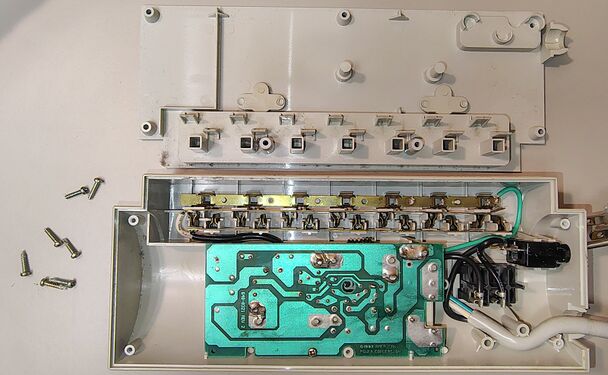 Initial internal view following enclosure removal.
 -
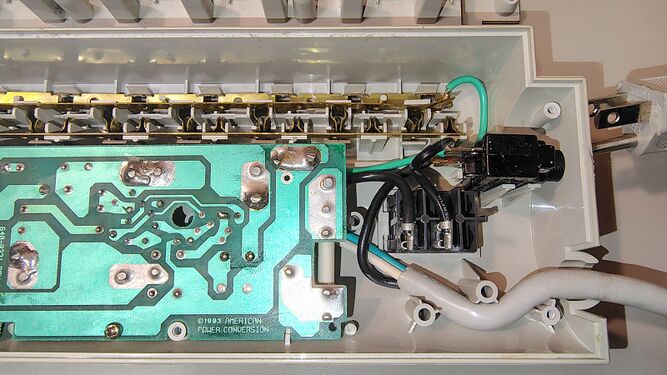 Cord-entry end showing the ©1993 suppression board, switch assembly, wiring, and outlet-contact strips.
 -
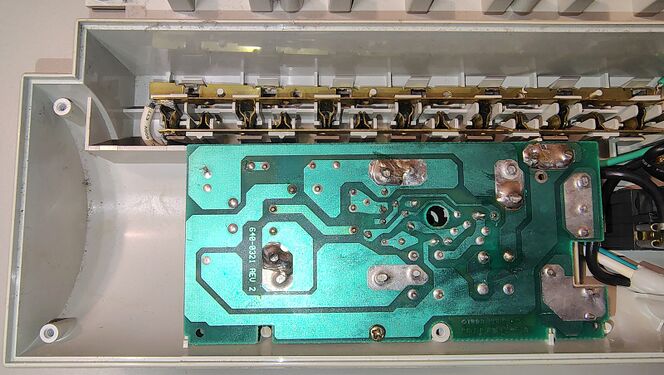 Left side of the lower enclosure showing the suppression board, brass outlet-contact strips, and internal layout.
 -
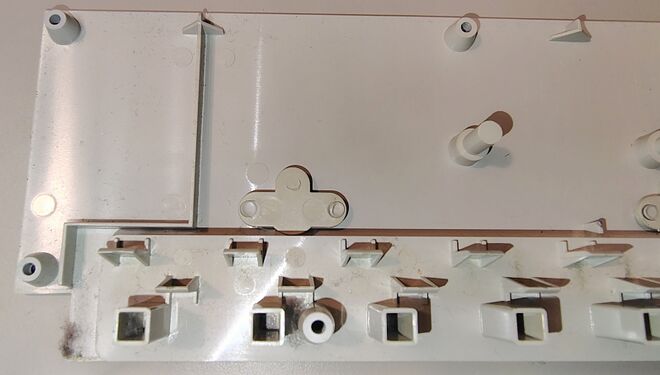 Interior of the upper enclosure showing molded outlet supports and enclosure construction.
 -
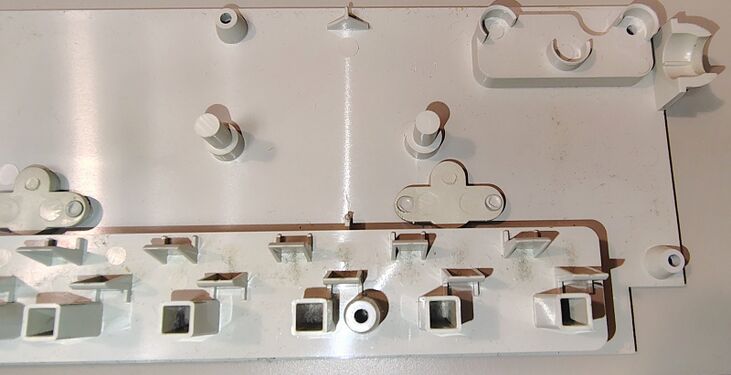 Interior of the upper enclosure showing molded outlet supports, switch mounting features, and enclosure details.
 -
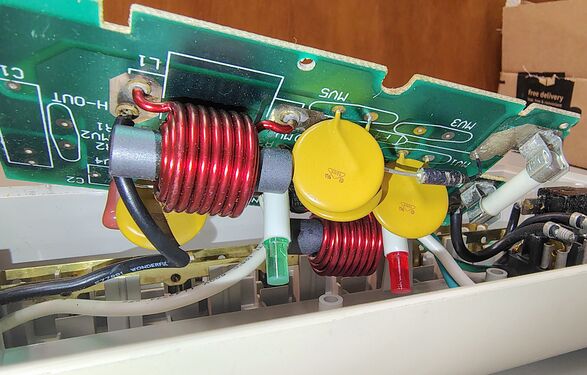 Suppression components including filtering inductors, MOVs, and protection circuitry mounted on the ©1993 board.
 -
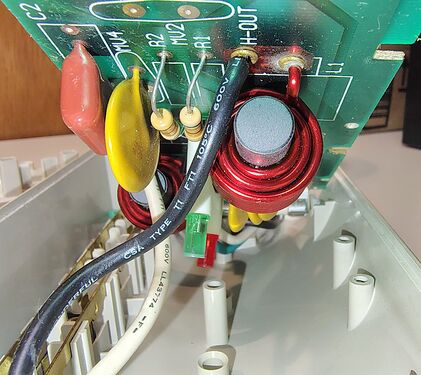 Additional view of suppression components and filtering circuitry on the ©1993 board.
 -
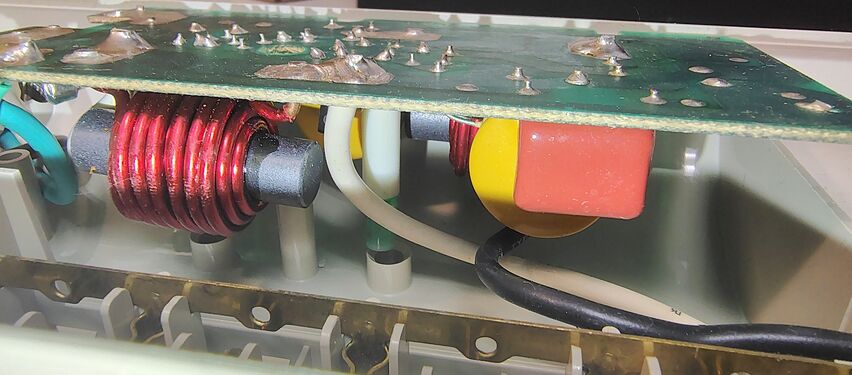 Low-angle view of the ©1993 suppression board showing filtering inductors, suppression components, wiring, and outlet-contact strips.


Construction
The APC PRO7 utilizes a two-piece molded-plastic enclosure secured with Phillips-head screws.
Power distribution is accomplished through full-length brass outlet-contact strips supported by molded outlet structures integrated into the enclosure.
The documented example incorporates a dedicated suppression board, rocker-switch assembly, indicator-light circuitry, cartridge fuse, toroidal filtering inductors, metal-oxide varistors (MOVs), and discrete passive components.
Internal examination confirmed the use of a ©1993 American Power Conversion suppression board identified as revision 614-0321 REV 2.
The overall construction emphasizes heavy-duty power distribution, surge suppression, and EMI/RFI filtering while maintaining the characteristic seven-outlet APC SurgeArrest Professional layout.
Notes
- Earliest APC PRO7 currently documented by the OldSurge Archive.
- Utilizes a straight-blade attachment plug rather than the right-angle plug used on later documented examples.
- Features an early Professional SurgeArrest logo design.
- Internal examination identified suppression-board revision 614-0321 REV 2.
- Internal circuitry includes multiple MOVs, large toroidal inductors, and a cartridge fuse.
- Despite being manufactured in 1994, the unit remained functional during testing.